
REA.A Marie Skłodowska-Curie Actions & Support to Experts A.3 MSCA Staff Exchanges

Inside Rocinha: the invisible architecture of informality and resilience
Eduard Mihai Manta and Adriana AnaMaria Davidescu
Bucharest University of Economic Studies (BUES)
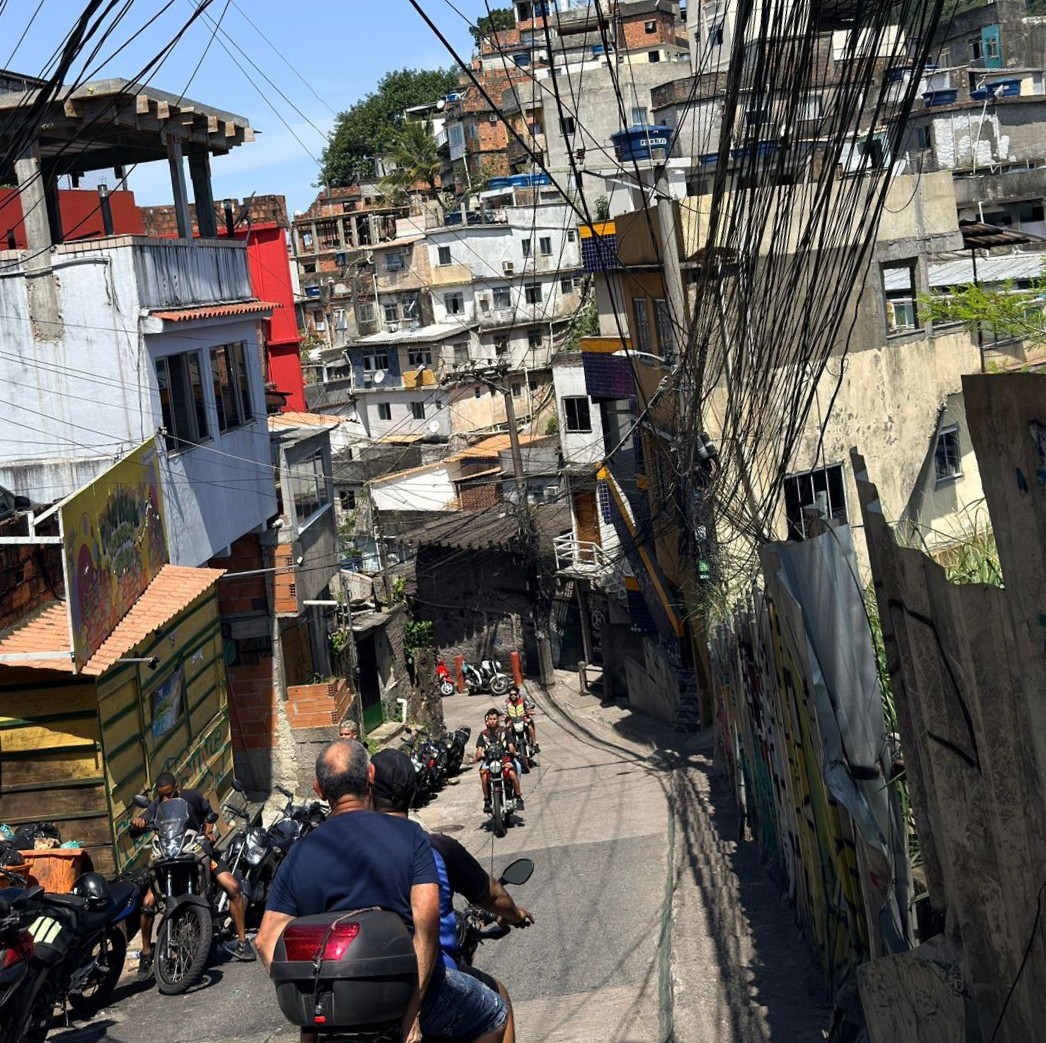
Rocinha greets you long before you reach its narrow alleys. The soundscape changes first, the steady hum of Rio’s formal city gives way to a vibrant mix of moto-taxis weaving through impossible curves, music spilling from windows stacked tightly on top of one another, and the chatter of street vendors negotiating their morning sales. As you climb higher, houses cling to the hillside in a dense mosaic of colours and improvised architecture, revealing a world that has grown upward and outward in response to every economic pressure and every human need.
Walking through Rocinha feels like moving through a living organism. Electricity cables trace the paths of opportunity, water pipes snake along walls with an improvised logic, and every doorway hosts a micro-enterprise, from beauty salons carved into living rooms to bakeries operating from a single oven. There is dynamism, ingenuity, and a constant sense of people making life work with whatever tools, networks, and constraints they have.
Yet the contrast with formal Rio de Janeiro is unmistakable. Just a few hundred meters below lie the ordered avenues of São Conrado and the luxury towers of Gávea, worlds built on regulation, planning, and formal markets. Rocinha, by contrast, thrives in the spaces where institutions withdraw or fall short. And it is precisely in these margins that informality becomes not only a survival strategy, but a defining feature of local economic and social systems.
This lived contrast, between formal structures and informal realities, is what makes Rocinha more than a neighbourhood. It is a complex laboratory of adaptation, resilience, and socioeconomic negotiation. Understanding how informality shapes this space is essential for anyone studying regional development, inequality, and the hidden mechanisms that sustain urban life across Latin America.
What is Rocinha? Location, history, and urban dynamics
Rocinha is located on a steep hillside in Rio de Janeiro’s South Zone, squeezed between two of the city’s wealthiest neighbourhoods — São Conrado and Gávea. This strategic yet constrained location makes Rocinha both highly visible and deeply integrated into Rio’s urban fabric. Despite occupying less than one square kilometre of land, Rocinha is home to an estimated 150,000 residents, although unofficial counts often exceed 200,000, reflecting its rapid and largely unregulated expansion.
Population density reaches more than 40,000 inhabitants per square kilometre, making Rocinha one of the densest urban settlements in Latin America. The favela grows vertically as much as horizontally: multi-storey houses rise from foundations never designed to support them, following a pattern of “incremental urbanism” where homes, shops, and informal infrastructure are added over time as families and incomes expand. This spatial pressure reflects both the scarcity of formal housing opportunities and the constant negotiation between community needs and physical limits.
The origins of favelas in Brazil date back to the early 20th century, rooted in structural inequalities that shaped Rio’s urbanization. Several interlinked dynamics contributed to the formation of these informal settlements:
- Post-abolition social exclusion (after 1888) left formerly enslaved populations without access to formal land ownership or employment opportunities.
- Rural–urban migration, particularly during industrial expansion in the 1930s–1950s, flooded Rio with workers seeking opportunities but unable to afford formal housing.
- Severe housing shortages and the failure of municipal planning created a gap that informal construction filled rapidly.
- Segregated development policies pushed low-income populations to peripheral or marginal land, steep hillsides, flood-prone areas, or geographically difficult terrain, where the state presence was minimal.
Favelas thus emerged not as chaotic accidents, but as structurally induced responses to poverty, exclusion, and limited access to formal markets. They evolved into resilient, self-organized communities with strong social networks and complex informal economies.
Unlike peripheral favelas, Rocinha is located in the heart of Rio’s most affluent region. This proximity intensified contrasts and made Rocinha a symbol of Brazil’s spatial inequality. Throughout the mid to late 20th century, Rocinha attracted migrants from Brazil’s Northeast and rural hinterlands. The favela expanded rapidly through informal construction, vertical growth, and the development of internal commercial corridors, turning it into a self-contained urban district.
Rocinha has long operated under a hybrid governance system, where community associations, local leaders, informal service providers, and, at times, criminal groups have coexisted or competed with state institutions. Public policies such as the UPP pacification programme temporarily increased formal state presence, but the sustainability of these interventions has been limited.
Rocinha became globally known through international documentaries, tourism circuits, and its visibility during mega-events such as the 2016 Olympics. This visibility helped reframe the favela not only as a site of poverty and violence, but also as a space of entrepreneurship, culture, and urban creativity.
Today, Rocinha is a microcosm of Rio’s broader tensions: rapid urban growth without adequate planning, vibrant informal economies interacting with formal markets, and a constant negotiation between resilience, vulnerability, and the right to the city.
Understanding informality: conceptual framework
Understanding Rocinha requires first understanding what scholars mean when they speak about informality. The notion has been shaped by several intellectual traditions. The International Labour Organization (ILO) defines the informal economy as all forms of work and entrepreneurship that operate outside, or only partially within, the protection of formal rules and institutions. In parallel, anthropologist Keith Hart, who first introduced the concept in the 1970s, emphasized the creativity and agency embedded in informal activities. Rather than viewing informality as disorder, Hart argued that people engage in it because it is often the most rational and accessible way to secure livelihoods when formal markets fail to offer opportunities. Later, economist Hernando de Soto highlighted a different dimension: informality emerges not from cultural preferences or individual decisions, but from institutional exclusion. According to this perspective, formalization is often too costly or bureaucratically demanding, pushing people toward informal arrangements that function more efficiently in their daily lives.
In practice, informality in places like Rocinha touches nearly every aspect of urban life. The labour market is dominated by jobs that rely on trust, immediacy, and informal contracts: moto-taxi drivers navigating the steep hillsides, street vendors selling food or clothing, construction workers hired on a day-to-day basis, and domestic workers commuting to wealthier districts nearby. Alongside these livelihoods, a vast ecosystem of small businesses flourishes. Many operate from the front rooms of homes or improvised storefronts, hair salons, bakeries, grocery shops, repair workshops, or tiny restaurants that serve the community from early morning to late evening. These enterprises provide essential goods and services in an environment where formal businesses cannot easily operate, either due to terrain, regulatory constraints, or the sheer pace at which life unfolds in the favela.
Housing itself is one of the clearest expressions of informality. Rocinha’s buildings rise vertically in an incremental manner, each floor added when a family grows or when savings allow for expansion. Most residents lack formal land titles, and construction follows a community-based logic rather than engineering blueprints. This form of urbanization is not accidental, it reflects decades of adaptation to limited space, high demand, and the near absence of affordable formal housing options.
Informality also governs how services are provided and how the community organizes itself. In areas where public institutions struggle to maintain a consistent presence, residents often rely on informal networks for safety, dispute resolution, or access to utilities such as electricity and water. Community associations, local leaders, and, at times, alternative governance structures fill the void left by the state. These arrangements are neither static nor uniform; they change continually in response to political pressures, economic opportunities, and community needs.
Favelas like Rocinha become hotspots of informality because multiple conditions converge. The presence of the state is uneven and often insufficient, especially in matters of infrastructure, policing, and land regulation. Legal frameworks fail to recognize the realities of self-built housing and micro-entrepreneurship, leaving residents to operate in a space where formal rules do not fully apply. And above all, communities develop their own strategies to cope with economic pressures, inequality, and exposure to risk. Informality, in this sense, is not simply a deficit, it is a system of adaptation. It allows Rocinha to function, to grow, and to sustain its population even in the face of longstanding structural barriers.
The anatomy of informality in Rochina
To understand Rocinha, one must look closely at how informality weaves through the daily rhythms of work, housing, mobility, and governance. The favela operates as a dense ecosystem where economic necessity, social networks, and physical constraints come together to form a parallel urban system, one that often functions more efficiently than the formal city surrounding it.
Informal labour forms the backbone of Rocinha’s economy. Much of the work that sustains the community takes place outside formal contracts or regulatory oversight. Street vendors set up stalls at dawn, offering everything from fresh fruit to mobile phone accessories. Construction workers find employment through word of mouth, moving from house to house as new floors are added or old structures repaired. Moto-taxi drivers, perhaps the most iconic workers in Rocinha, navigate the steep curves and narrow alleys with a speed and precision that only years of experience can teach. They are essential not just for transportation, but also for delivering food, medicines, and household supplies. Recycling collectors, domestic workers, electricians, and handymen all play roles in a labour market shaped by flexibility and immediate need. In a place where formal employment opportunities remain scarce, informality becomes both a survival mechanism and a crucial source of dynamism.
Entrepreneurship flourishes with equal vitality. Rocinha is a dense patchwork of micro-businesses, tiny grocery shops carved into the ground floors of homes; hair salons where stylists work side by side with living spaces; bakeries producing pão francês from a single oven; repair workshops specializing in electronics, smartphones, or household appliances; and food kiosks serving meals to residents who pass by in a constant flow. Many of these enterprises begin with minimal capital and rely heavily on personal trust, family networks, and reputation. They reflect a form of “necessity entrepreneurship,” but also creativity: an ability to transform limited resources into functioning businesses that meet community needs. Despite the absence of formal permits or business infrastructure, these ventures are embedded in the social fabric and contribute to the favela’s economic resilience.
Housing and infrastructure reveal another layer of informality, perhaps the most striking visually. Rocinha has grown through decades of self-built construction, expanding vertically as much as horizontally. Homes often start as single-story structures and gradually rise, one floor at a time, as families grow or as rent from upper levels becomes necessary. The architecture is improvisational, a patchwork of bricks, concrete, and metal beams shaped less by building codes than by ingenuity and spatial necessity. Access to water, electricity, and internet often follows a similar logic: cables run across rooftops and along walls in intricate webs; pipes are installed collectively; services are shared, redistributed, or informally connected. These systems may look chaotic from the outside, but inside the community they represent a functioning, if fragile, network built through cooperation and adaptation.
Mobility within Rocinha also has its own informal logic, shaped by geography and necessity. The steep slopes and narrow alleys make traditional transportation nearly impossible. Moto-taxis fill this gap with remarkable efficiency, forming an extensive network that moves thousands of residents daily. Informal delivery chains have emerged alongside them, ensuring that food, groceries, construction materials, and even furniture reach households scattered across the hillside. These logistical systems are agile and responsive in ways that formal urban services rarely achieve, illustrating how informality can create functional solutions in environments where conventional infrastructure fails.
Finally, governance in Rocinha exists in a hybrid form that reflects the uneven presence of the state. Public institutions are present, schools, health posts, and some policing, but their influence is inconsistent. In the gaps left behind, community organizations take on essential roles. Neighbourhood associations manage disputes, coordinate improvements, and advocate for residents. Informal leaders emerge as intermediaries between the community and external institutions. In some periods of Rocinha’s history, alternative power structures, including criminal groups, have exerted significant control, regulating territory and influencing daily life. These forms of governance are neither fully formal nor entirely informal; they occupy a fluid space shaped by historical legacies, political pressures, and local needs.
Taken together, these layers-labour, entrepreneurship, housing, mobility, governance; show that informality in Rocinha is not a marginal or residual phenomenon. It is a complex, systemic, and deeply embedded urban order. Far from being a temporary solution, it represents a parallel mode of city-making that emerges when formal systems fail to provide adequate opportunities or support. Rocinha’s informality is thus not only a condition but a process: a dynamic response to inequality, exclusion, and the everyday reality of living in one of the world’s most densely populated urban environments.
Resilience, social networks, and community economies
Resilience in Rocinha does not emerge from formal institutions or state planning; it grows from within the community itself. In many ways, social cohesion functions as an informal institution; an unwritten system of norms, trust, and mutual obligation that enables the neighbourhood to confront daily challenges. Families rely on extended networks of friends, neighbours, and co-workers to find jobs, share resources, supervise children, and navigate periods of economic hardship. These relationships are the social infrastructure that allows life to continue even when formal protections such as social insurance or stable contracts are absent.
Community-based adaptation mechanisms are everywhere. When a family needs to expand their house, neighbours assist with labour and materials. When a business owner faces a temporary downturn, informal credit networks step in to provide small loans. During power outages or water interruptions, residents mobilize collectively to restore improvised connections. These systems may appear invisible to outsiders, but they are highly organized forms of collective problem-solving that reflect deep reservoirs of trust and cooperation.
In moments of crisis such as storms, landslides, sudden economic shocks, the strength of these networks becomes even more visible. Mutual aid groups form spontaneously, food and supplies circulate quickly, and residents coordinate responses long before external assistance arrives. Rocinha’s capacity to self-organize under pressure is not accidental; it is a product of decades spent building parallel systems where the state has been inconsistent or absent. This collective resilience helps explain why informality persists. It is not simply a fallback option but a social and economic logic that provides flexibility, stability, and communal security in ways that formal systems often cannot.
Development challenges and policy paradoxes
Despite its vitality, Rocinha’s informal system exists alongside profound vulnerabilities. The same flexibility that sustains livelihoods also exposes residents to significant risk. Income is often unpredictable, fluctuating with seasonal work, shifting demand, or changes in the local security situation. Access to credit is limited, pushing families toward informal lenders or rotating savings groups with no legal protection. Housing, while innovative and adaptive, is frequently precarious; self-built structures perched on steep slopes are vulnerable to heavy rains, landslides, and infrastructure failures. These structural vulnerabilities highlight the delicate balance that residents must navigate between economic opportunity and everyday risk.
Efforts to address these challenges through formalization policies have often produced paradoxical outcomes. When governments attempt to introduce stricter regulation, enforce formal building codes, or push for standardized business licensing, they may unintentionally disrupt the very systems that keep the community functioning. A street vendor forced to operate within formal taxation rules may lose competitiveness; a moto-taxi driver required to acquire a costly license might lose their only livelihood; a family obligated to retrofit their house to meet formal codes may face eviction or unaffordable costs. Well-intentioned interventions can therefore undermine local economies, increasing vulnerability rather than reducing it.
This is why top-down policies frequently encounter resistance. Without a nuanced understanding of how Rocinha’s informal systems actually operate, formalization risks erasing existing forms of stability without offering viable alternatives. Genuine development requires acknowledging that informality is not merely the absence of formality but a parallel economic and social order that responds efficiently to the constraints imposed by urban inequality.
Spatial inequality reinforces these dynamics. Rocinha exists in sharp contrast to the affluent neighbourhoods that surround it, creating a visual and economic boundary that shapes residents’ opportunities. Yet informality also mitigates some aspects of inequality by providing goods and services at prices that match local incomes, by creating employment opportunities that the formal sector does not offer, and by enabling mobility through informal transport networks. In other words, informality both reflects and softens the inequalities of the wider city.
Rocinha’s story reveals a complex tension: formal policies seek to regulate, order, and standardize urban life, while informal systems seek to adapt, improvise, and survive. Development in such settings cannot rely solely on formal tools. It requires an understanding of informality as a form of urban intelligence, a set of practices that, despite their fragility, sustain millions of livelihoods and keep the city moving.
Rocinha in the broader Latin American context
Rocinha is often portrayed as a uniquely Brazilian phenomenon, yet its underlying dynamics echo across urban landscapes throughout Latin America. Cities such as Bogotá, Lima, Mexico City, Buenos Aires, and Caracas all contain settlements that emerged from similar historical forces: rapid rural–urban migration, insufficient public housing, uneven economic development, and persistent territorial inequality. Rocinha’s narrow alleys, improvised architecture, informal transportation networks, and dense webs of micro-entrepreneurship mirror the comunas of Medellín, the barrios populares of Lima, or the villas miseria of Buenos Aires.
What makes Rocinha distinctive is not the presence of informality itself, informality is a defining feature of Latin American urbanization, but the intensity of spatial contrast. Few places display such an immediate juxtaposition between wealth and precarity: luxury apartments, gated communities, and high-end shopping centres sit only meters away from self-built homes and improvised infrastructures. This spatial compression magnifies both the inequalities and the interdependencies between the formal and informal city. Residents of Rocinha provide essential labour, services, and economic activity to nearby affluent districts, while simultaneously being excluded from many of the benefits those districts enjoy.
In this sense, Rocinha exemplifies what scholars describe as dual urbanism: two systems of city-making coexisting, interacting, and depending on each other. The favela is not an isolated enclave but an integral part of Rio’s wider metropolitan economy. Understanding Rocinha’s informality therefore contributes to a broader comparative perspective within Latin America, where similar patterns reveal how structural constraints, state absence, and community innovation shape the urban future of the region.
Final thoughts
Visiting Rocinha reveals more than a neighbourhood; it uncovers an entire logic of urban life that remains invisible to those who only observe cities through the lens of formal institutions. The favela does not conform to conventional models of planning or governance, yet it operates with a coherence shaped by necessity, cooperation, and ingenuity. Its narrow pathways, bustling storefronts, and improvised homes tell a story of people building their own solutions in the face of enduring exclusion.
What becomes clear in Rocinha is that informality is not a temporary condition that will simply fade as the city develops. It is a structural feature of how people survive and thrive in contexts where institutions fall short. Informality enables resilience, supports local economies, and fosters intense forms of social cohesion. At the same time, it carries undeniable vulnerabilities that demand sensitive, well-informed policy responses rather than simplistic calls for formalization.
For researchers working on development, inequality, and urban resilience, such as those within the INSEAI network, Rocinha offers a living laboratory. It challenges assumptions about what constitutes a functional city and invites us to see urban life in its full complexity. Standing on one of the favela’s terraces, overlooking the mosaic of rooftops stretching toward the sea, it becomes impossible to ignore the interplay between exclusion and creativity, vulnerability and strength, hardship and hope. Rocinha reminds us that understanding informality is not only a scientific exercise but an ethical one: it requires seeing the invisible systems that sustain millions of lives and acknowledging their place in the story of urban Latin America.

International Network for Knowledge and Comparative Socioeconomic Analysis of Informality and the Policies to be Implemented for their Formalization in the European Union and Latin America
Horizon Europe Project 101182756 — INSEAI 2023 REA.A
Marie Skłodowska-Curie Actions & Support to Experts A.3
MSCA Staff Exchanges