
INSEAI Newsletter 2026/10 - October
Project & Network Highlights l October 2026
October brought a varied programme of scientific exchange across the INSEAI network , with discussions connecting labour informality to occupational change, construction, digital platforms, legal frameworks and access to housing.
The month’s lectures and discussions combined perspectives from Europe and Latin America, examining how informality takes shape across different sectors and institutional settings. Research secondments continued to support these exchanges, linking ongoing investigations with opportunities for discussion among partner institutions.
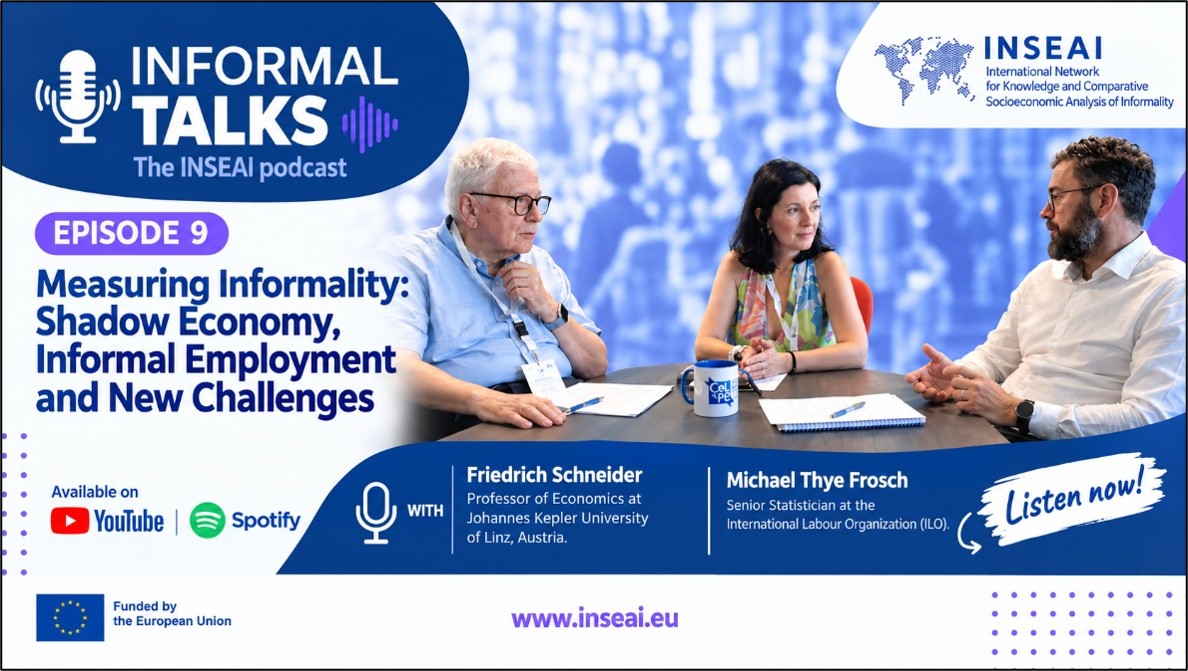
Informal Talks #09 : Adriana Davidescu in conversation with Friedrich Schneider and Michael T. Frosch on measuring informality, the shadow economy and informal employment.
INSEAI’s dissemination activities also expanded through a new blog contribution on the international statistical framework for measuring the informal economy, a testimony on Spain and an episode of Informal Talks bringing together Friedrich Schneider and Michael Frosch. The new initiative Informality: The State of the Art adds accessible reviews of academic publications to the network’s communication channels.
Meanwhile, preparations advanced for a comparative database on digitalisation and informality, with surveys planned in seven European and Latin American countries. This initiative will open further opportunities for joint research and methodological exchange.
With the workshops in A Coruña and Porto approaching, October connected ongoing research and dissemination with preparations for the network’s forthcoming scientific meetings.
Network Cooperation
|
Research mobility continued to strengthen cooperation across the INSEAI network in October, connecting partner institutions and supporting comparative research on employment and informality |
Solange Rodríguez Espínola (UCA-ODSA, Argentina) completed her secondment at the Universitat de València , which ran from 8 September to 9 October 2026. Her stay provided opportunities for academic exchange between the Argentine and Spanish teams, including discussion of the relationship between employment status and health in both countries.
At the University of Alicante, Daniel Contartese ( UNTREF/FUOCRA, Argentina ) undertook a research secondment during which he contributed to the network’s scientific programme with a lecture on Argentina’s construction labour market. The stay connected his research on employment and labour informality with colleagues at the host institution.
Cooperation between Spain and Mexico also informed the research presented by Miguel Ángel Casaú ( Universidad Autónoma de Madrid ) in October. Developed during a two-month INSEAI secondment at the Belisario Domínguez Institute of the Mexican Senate, in collaboration with Jesuswaldo Martínez Soria, the study examines occupational change and informality in Mexico from an input-output perspective.
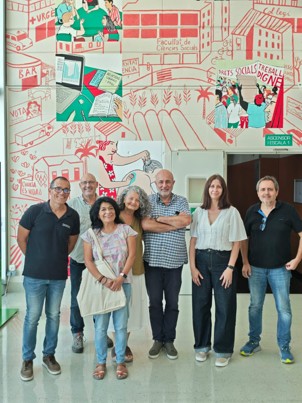
Solange Rodríguez Espínola ( UCA-ODSA, Argentina ) with colleagues at the Universitat de València during her INSEAI secondment, 8 September–9 October 2026.
|
These activities illustrate how INSEAI secondments support joint research and create opportunities to discuss findings across institutions and national contexts. Discussion SeriesOctober’s scientific programme explored informality through five complementary perspectives, bringing together research on occupational structures, sectoral employment, labour law, digital platforms and housing. |
On 1 October , Miguel Ángel Casaú (Universidad Autónoma de Madrid) presented “Patterns of Occupational Change and Informality in Mexico from an Input-Output Perspective”. Developed in collaboration with Jesuswaldo Martínez Soria, who moderated the session, the study examines changes between 2012 and 2024. Its findings show that informal employment remains concentrated in occupations of low and middle socioeconomic status, while productive transformation contributes more strongly to formal employment in higher-level occupations.
On 8 October , Daniel Contartese (UNTREF/FUOCRA, Argentina) delivered “The Construction Labour Market in Argentina: Characteristics, Evolution, and an Approach to Formality and Informality among Workers and Productive Units”. Organised by Víctor Climent at the University of Alicante, where Contartese was undertaking a research secondment, the session addressed the sector’s employment characteristics and the relationship between formality and informality among workers and productive units.
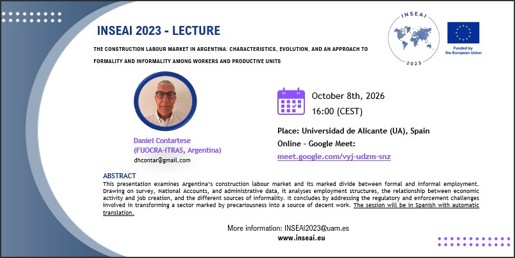
Daniel Contartese (FUOCRA-ITRAS, Argentina) presented his research on construction labour informality at the University of Alicante, 8 October 2026.
On 15 October , Luis Gordo (Universidad Autónoma de Madrid) presented “Towards a Legal Concept of Informal Work: Evolution, Scope, and Unresolved Challenges in Technology-Based Informal Work”. Organised by Julimar Da Silva and moderated by Jesuswaldo Martínez Soria, the lecture examined the difficulties of defining informal work from a labour law perspective. Particular attention was given to digital platforms, algorithmic management, the legal classification of employment relationships and gaps in social protection.
On 23 October , Alfredo Hualde Alfaro ( El Colegio de la Frontera Norte, Mexico ) delivered “Regulated Flexibility and Uneven Formalisation: Work on Digital Platforms in Mexico”. Organised and moderated by J. Verónica Ramírez Rangel and Raúl Lorente Campos at the Universitat de València, the lecture addressed the relationship between platform work, regulation and uneven processes of formalisation in the Mexican context.
On 28 October , Paulo Echegaray, Secretary of Housing at Movimiento Evita and Co-Head of the Construction Branch at UTEP (Argentina) , presented “Struggles for Fair Access to Housing in Informal Settings: Securing Laws Centered on Community Participation in Decision-Making and Social Inclusion”. Organised by Raúl Lorente during Echegaray’s research stay at the Universitat de València, the discussion brought housing and community participation into the programme, highlighting their connections with informality and social inclusion.
Together, these sessions connected the analysis of informal employment with broader questions of productive change, legal protection and access to social rights.
INSEAI: Blog & Testimonies
October brought new contributions to INSEAI’s communication channels, with a particular focus on how informality is defined, measured and understood across different national contexts.
The INSEAI Blog featured “ The Informal Economy: A New International Statistical Framework ”, by Michael Frosch of the International Labour Organization (ILO). Drawing on the resolution adopted by the International Conference of Labour Statisticians in 2023, the article explains the importance of common definitions and consistent measurement. This framework supports international data comparability and provides a stronger evidence base for policymaking.
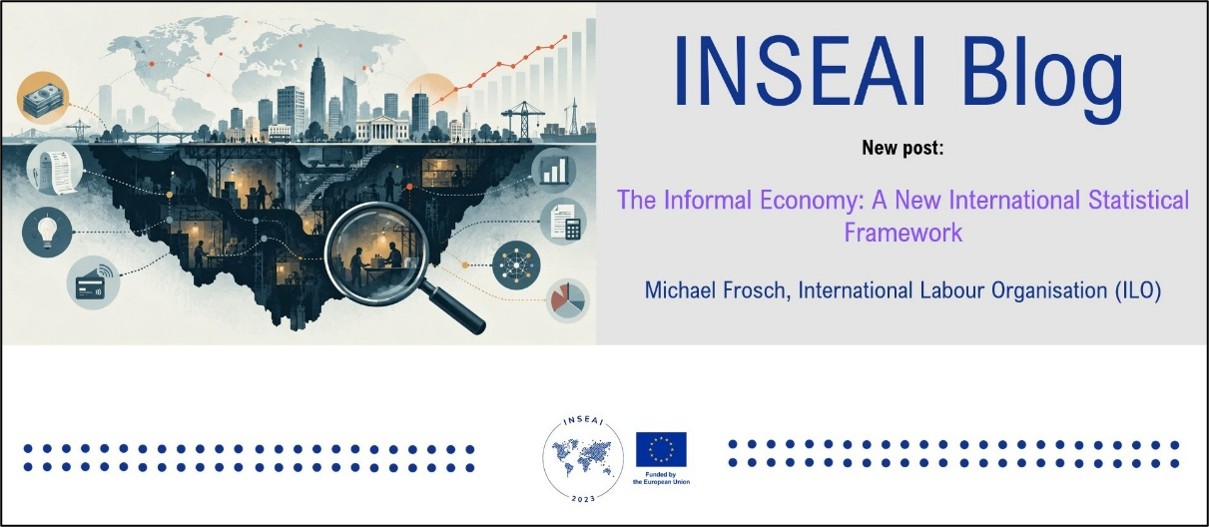
INSEAI Blog: Michael Frosch (ILO) explores the new international statistical framework for defining and measuring the informal economy.
The INSEAI Testimony Collection continued with a contribution from Empar Aguado Bloise, professor and researcher in the Department of Sociology and Social Anthropology at the Universitat de València, Spain. Drawing on her research interests in the sociology of work, gender studies and feminist economics, she shares her perspective on informality in Spain. The episode is available on the project’s YouTube channel with English subtitles.
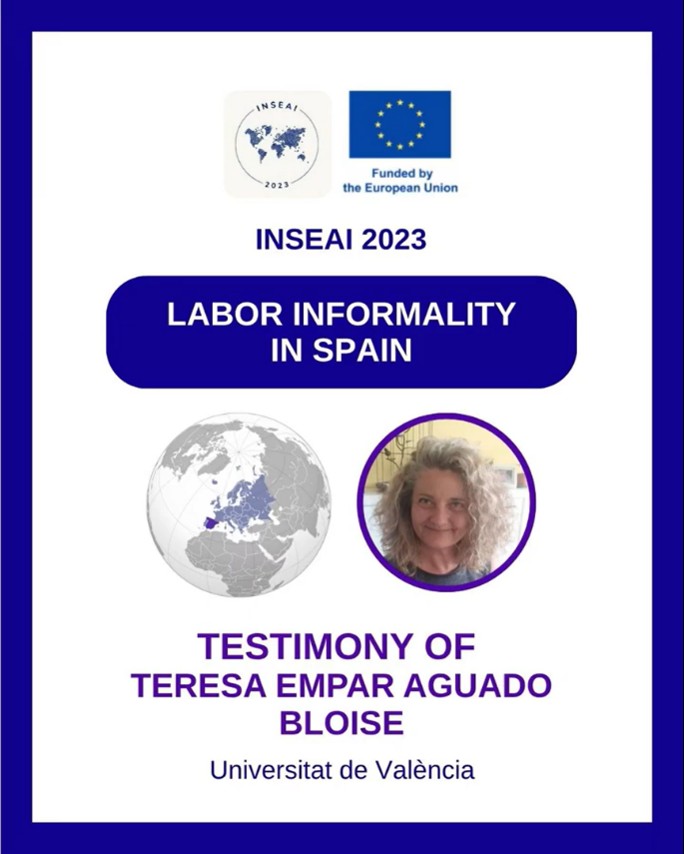
INSEAI Testimony: Empar Aguado Bloise (Universitat de València) discusses labour informality in Spain.
A new episode of Informal Talks brought together Friedrich Schneider, Professor of Economics at Johannes Kepler University Linz, and Michael T. Frosch, Senior Statistician at the ILO. The conversation was hosted by Adriana Davidescu, Professor of Statistics and Econometrics, Founder and Coordinator of the Business Economics Data Science Lab at the Bucharest University of Economic Studies (BUES, Romania), and local coordinator of the INSEAI network. Their exchange explored the concepts, data and measurement tools used to study the informal and shadow economies, alongside the challenges posed by changing labour markets. The episode is available on YouTube and Spotify.
October also saw the introduction of Informality: The State of the Art , a dissemination initiative offering accessible, concise reviews of key academic publications. Prepared with the support of AI tools and guided by INSEAI network members, these reviews aim to broaden understanding of informality and its socioeconomic implications while encouraging readers to explore the original research in greater depth.
Looking ahead
November will bring two major scientific meetings and the launch of a new comparative research initiative on digitalisation and informality.
The 3rd INSEAI Workshop will take place on 26–27 November 2026 at the Faculty of Economics and Business of the University of A Coruña , with on-site and online participation. Under the theme “Economic, Juridical and Political Frameworks and Cultural and Moral Beliefs. Informality and Socioeconomic Inequalities and Well-being”, the meeting will examine how institutional, cultural and social factors shape informal practices and their consequences.
Shortly afterwards, the 4th INSEAI Workshop , “Informality, Mobility and Migration”, will take place in Porto on 30 November–1 December 2026 , also in hybrid format. The programme will explore the connections between informality, labour mobility and migration, with particular attention to gender, digital technologies, inclusion and regulation.
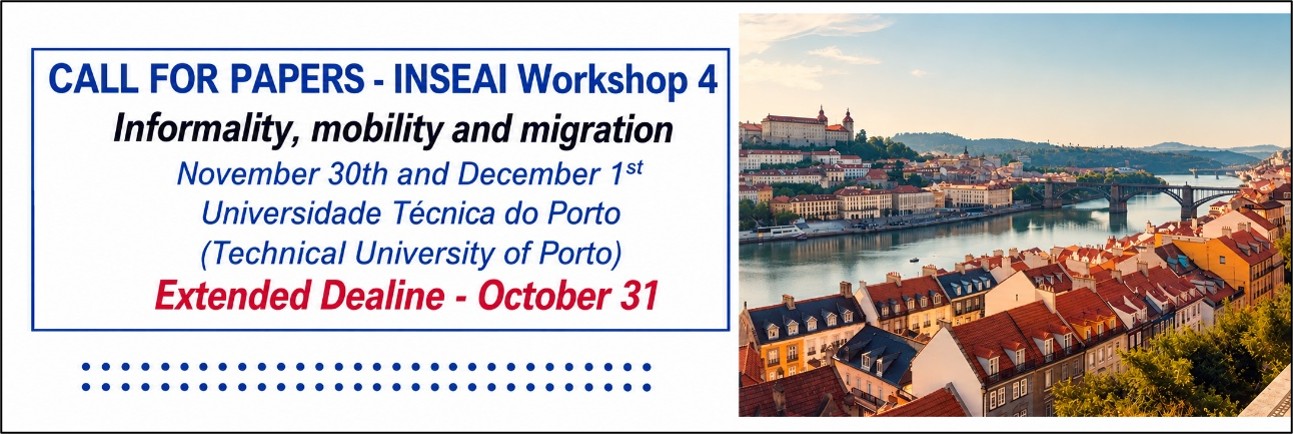
The 4th INSEAI Workshop, “Informality, Mobility and Migration”, will take place in Porto on 30 November–1 December 2026.
November will also mark the start of work on a new database on digitalisation and informality , with approximately 1,500 questionnaires planned in each of seven countries : Argentina, Brazil and Mexico in Latin America, and Germany, Spain, Italy and Poland in Europe. The initiative aims to create a comparative resource that will become available to interested researchers once the necessary statistical and technical procedures have been completed. The initiative is led by Raúl Lorente, Agustín Salvia and Víctor Climent, bringing together teams from partner institutions to develop a shared resource for comparative research on digitalisation and informality.

INSEAI’s forthcoming survey on digitalisation and informality. AI-generated illustration.
An open research group is being established alongside the database to support scientific exchange and develop further research opportunities. On 4 November , the ODSA-UCA team will present the methodological experience of designing and implementing Argentina’s EDSA Foco–Trabajador Digital survey, together with its initial findings and conclusions. A further seminar is planned for 26 November , in A Coruña and online, in connection with the 3rd INSEAI Workshop. Network members interested in contributing to this research initiative are invited to contact Raúl Lorente .
Secondment Chronicle
By Adriana Anamaria Davidescu, Tamara Maria Nae, Maria-Cristina Geambașu, Eduard Mihai Manta, Ioana Bîrlan, Maria-Bianca Bolboașă, Vasile Alecsandru Strat, Diana Marina Agafiței, Alina Luchian and Gianina Petrașcu ( BEDSL – Bucharest University of Economic Studies )
Our secondment in Italy brought us together around a shared purpose: the co-organisation of the 2nd INSEAI Workshop. What began as a working visit became something richer, reminding us that some of the most meaningful moments of an international meeting happen beyond the presentations: over coffee, during walks back to the hotel and around dinner tables where conversations continue long after the official programme ends.
Hosted by the University of Salerno in collaboration with the Bucharest University of Economic Studies (BUES), the workshop brought together colleagues who had spent months collaborating online, welcoming one another during secondments and developing research on labour informality across Europe and Latin America. Meeting in person gave tangible meaning to the cooperation that INSEAI has been building.
The Business Economics Data Science Lab (BEDSL) team contributed to both the scientific programme and its organisation. Tamara Maria Nae, Maria-Cristina Geambașu, Maria-Bianca Bolboașă and Eduard Mihai Manta served as session chairs, guiding discussions and helping create an environment where research could be openly examined and refined.
One of the greatest pleasures was reconnecting with colleagues who had previously hosted members of our team. These included Esteban Nina from Pontificia Universidad Javeriana in Bogotá and Ianina Tuñón from Pontificia Universidad Católica Argentina. Exchanges with partners from DESH Consultores and Alban Asllani from the Royal Docks School of Business and Law further strengthened the relationships connecting our institutions.
The scientific programme offered opportunities to learn from different approaches to informality. Michael Frosch, Senior Statistician at the International Labour Organization, addressed labour statistics and measurement challenges. Friedrich Schneider shared insights from his extensive research on the shadow economy, while Agustín Salvia, Director of the Argentine Social Debt Observatory, connected empirical evidence with broader questions of social development and public policy.
A particularly memorable moment took place in the CELPE office at the University of Salerno , where we recorded an episode of Informal Talks . Hosted by Adriana Anamaria Davidescu, the conversation brought together Friedrich Schneider and Michael Frosch to discuss the meaning of the shadow and informal economies, the evolution of measurement standards and the challenges of capturing informality across Europe and Latin America. The warm, collegial setting made the recording a rewarding experience.
The workshop also provided an opportunity to share progress within Work Package 2 , dedicated to compiling informality statistics and databases across the Euro-Latin American region. Adriana Anamaria Davidescu presented A Multidimensional Informality Dashboard for Romania: Indicators, Data Sources, and Monitoring Framework . Building on this experience, a corresponding catalogue for Italy is planned in cooperation with CELPE colleagues during a forthcoming secondment at the University of Salerno.
Our sincere thanks go to Roberto Dell’Anno, Lavinia Parisi and Antonio Abatemarco for their organisation and hospitality, and to project coordinators Santos M. Ruesga and Julimar da Silva Bichara for their continued support for this international research community.
We left Salerno with new research ideas, constructive feedback and plans for future collaboration. We also carried home a stronger sense of belonging: behind every dataset, model and publication stands a community of people whose relationships help make scientific cooperation possible.
Cultural Corner: Recommended Reading
This month’s recommended reading is the International Labour Organization’s World Employment and Social Outlook 2021: The Role of Digital Labour Platforms in Transforming the World of Work.
Drawing on surveys and interviews with around 12,000 workers and representatives of 85 businesses worldwide, the report examines how digital platforms are changing the organisation of work. It covers both online platforms, where tasks are performed remotely, and location-based services such as delivery and passenger transport.
The report explores platform business models, workers’ experiences and regulatory responses, offering a useful foundation for understanding the relationship between technological change, employment opportunities and decent work.
Its international perspective complements October’s INSEAI discussions on platform work and provides background reading for the network’s forthcoming comparative research on digitalisation and informality.
Read the report on the ILO website .
ILO report on digital labour platforms and the changing world of work (2021).
Contact & Stay Connected
Website: www.inseai.eu
Email: info@inseai.es
LinkedIn: https://www.linkedin.com/in/inseai-project-471875371
Instagram: https://www.instagram.com/inseai.project/
Facebook: https://www.facebook.com/people/Inseai/61576239562950/
YouTube: https://www.youtube.com/@INSEAI-PROJECT
Spotify: https://open.spotify.com/
Calendar INSEAI Upcoming Events: https://www.inseai.eu/es/eventos
- Newsletter Team: Matías Membiela-Pollán (Coord.), Xose Picatoste-Novo, Sandrina Teixeira.

International Network for Knowledge and Comparative Socioeconomic Analysis of Informality and the Policies to be Implemented for their Formalization in the European Union and Latin America
Horizon Europe Project 101182756 — INSEAI 2023