
INSEAI Newsletter 2026/7 - July
Project & Network Highlights l July 2026
July brought together several dimensions that have become increasingly interconnected as INSEAI moves forward in its second year: methodological development, comparative research, international mobility and the preparation of the network’s next major activities.
Across the month, researchers worked on new approaches to measuring informality, from the development of comparative indicators and digital tools to methodological discussions on hidden and multidimensional forms of labour informality. At the same time, ongoing secondments continued to connect researchers and institutions across Europe and Latin America, creating opportunities to test ideas, exchange perspectives and consolidate collaborative research.
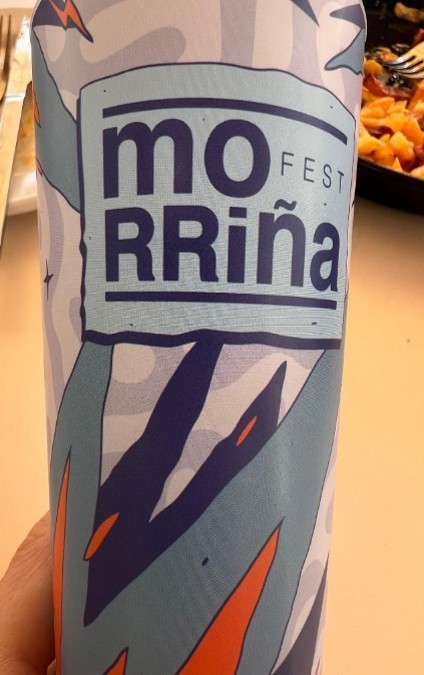
A summer touch from A Coruña: Morriña Fest, borrowing its name from the deeply Galician feeling of morriña. The city and the University of A Coruña remain closely connected to INSEAI, welcoming researchers through the network’s secondment programme.
Network Cooperation: Researching, Learning and debating across universities
The month also looked decisively towards the next stage of the project. Work progressed on new comparative surveys and on the preparation of the Third INSEAI Workshop, which will bring the network to A Coruña in November. Together, these activities reflect a project increasingly moving from the construction of common frameworks towards their application in comparative empirical research.
July saw important progress in collaborative research across the network, particularly in the development of new empirical tools.
A coordination meeting on the Digital Work Survey in Spain brought together researchers working on the adaptation of the questionnaire previously implemented in Argentina. The discussion focused on ensuring comparability while adapting the instrument to the Spanish labour-market context. Particular attention was given to dimensions such as platformisation, algorithmic intensity, salarisation and informalisation, alongside additional variables related to job satisfaction, collective networks and digitalisation.
The pilot is expected to move forward in September, opening the way for a broader comparative study and possible future expansion to other European and Latin American countries. Beyond the technical design of the questionnaire, the initiative illustrates one of INSEAI’s central objectives: developing shared analytical tools capable of capturing how informality changes across different institutional and technological environments. This data base research are conducted by Agustín Salvia (UBATEC), Janina Tuñon UCA-ODSA), Raúl Lorente (UV-EG) and Victor Climent (UA).
Discussion Series
July’s academic programme placed a particularly strong emphasis on the measurement of informality , approaching the issue from different methodological and national perspectives.
Javier Baquero Pérez and Daniel Fernández Romero ( UAM ) presented “Measuring the Dynamics of Informality: A Panel FAVAR Approach” . Their work proposed a methodology for estimating unobserved informality by combining multiple observable indicators across countries and over time. The approach offers a way of tracing the dynamics of informal economic activity while accounting for cross-country heterogeneity and the potential effects of policy shocks.
A complementary perspective came from Luis Ortiz ( Universidad Nacional de Asunción ) , currently on secondment at Lublin University of Technology. His lecture, “¿Informalidad o márgenes de productividad? Análisis de retornos retributivos en el mercado laboral paraguayo” , examined income differences according to occupational dedication, working hours and socio-occupational position in Paraguay, opening a broader discussion on productivity and incentives for labour-market formalisation.
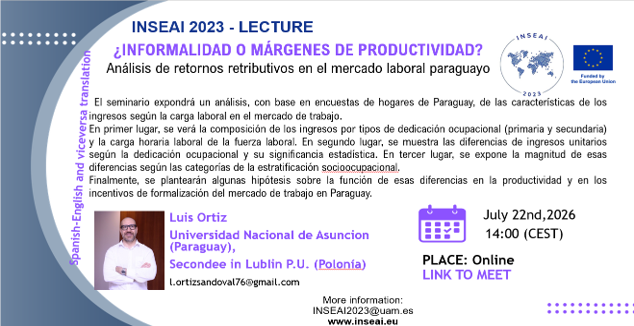
INSEAI Lecture by Luis Ortiz (Universidad Nacional de Asunción) on labour informality, productivity and income differences in the Paraguayan labour market.
The methodological debate was further enriched by Manuel Riveiro (University of Buenos Aires) , whose contribution addressed the theoretical, methodological and empirical challenges involved in measuring sex-gender relations. Rather than treating gender simply as an additional variable, the discussion highlighted how conceptual choices shape the categories, methods and evidence through which labour-market inequalities are analysed.
Towards the end of the month, the lecture “Measuring Informality Across Two Continents” presented a further step in INSEAI’s comparative agenda. Researchers from BUES (Romania) , together with INSEAI members from Italy and Colombia, introduced a pilot multidimensional dashboard designed to compile and compare informality indicators for Romania, Italy, Colombia and Brazil . Based on a harmonised indicator catalogue and common methodological protocol, the initiative seeks to improve comparability and traceability while bringing together multiple sources of information on informality.
Taken together, these contributions show how measuring informality requires more than a single indicator or methodological approach. Combining macroeconomic modelling, household data, multidimensional indicators and critical reflection on the categories used to produce evidence is becoming an increasingly important part of INSEAI’s comparative work.
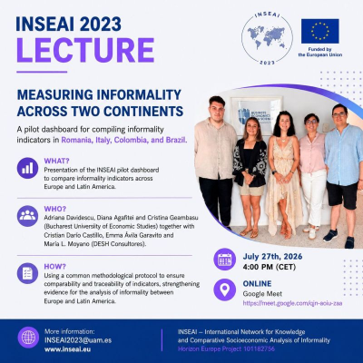
INSEAI Lecture “Measuring Informality Across Two Continents” , presenting a pilot dashboard for comparing informality indicators across Europe and Latin America.
Training & Research Development
July also highlighted the connection between INSEAI’s research agenda and the training of new researchers.
On 30 July, Ignacio Picatoste Novo (University of A Coruña), member of Inseai project, defendeded his doctoral thesis, “Fiscalidad, informalidad laboral y sostenibilidad social del trabajo. Una aproximación jurídico-económica desde el sector marítimo” ( “Taxation, informal employment and the social sustainability of work. A legal and economic approach from the maritime sector” ), receiving the highest distinction of Sobresaliente Cum Laude . The defence also marked an institutional milestone, as it was the first thesis with an International Doctorate distinction to be defended within the doctoral programme and at the Faculty of Labour Sciences.
The thesis is particularly relevant to the network as it was developed entirely within the framework of INSEAI : the doctoral candidate, Ignacio Picatoste Novo , his supervisor, M. Asunción López Arranz , and Santos M. Ruesga , INSEAI Project Coordinator and president of the examining committee, are all members of the project.
The thesis examines the relationship between taxation, labour informality and the social sustainability of work through the maritime sector. Combining legal, economic and institutional perspectives, it explores how formalisation, labour protection and institutional frameworks interact with the broader challenges of achieving a socially sustainable Blue Economy.
The examining committee further reflected the international and interdisciplinary character of this research. It was chaired by Santos M. Ruesga (Universidad Autónoma de Madrid) , with Rebecca Rose Nocella (Oxford Brookes University) as committee member and Fernando I. González Laxe (University of A Coruña) as secretary. The successful defence represents an important milestone for doctoral training within INSEAI and illustrates how the project’s research agenda is also contributing to the development of new interdisciplinary research on labour informality and socioeconomic sustainability.
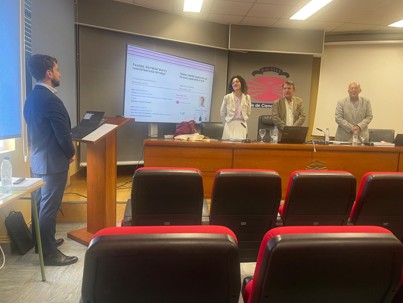
Ignacio Picatoste Novo during the presentation of his doctoral thesis on taxation, labour informality and the social sustainability of work in the maritime sector.
INSEAI: Blog & Testimonies
The INSEAI Blog also featured a new contribution by Juan Ignacio Bonfiglio (University of Buenos Aires), “Informalidad laboral, privaciones materiales y territorio en el Área Metropolitana de Buenos Aires” . The post explores the relationship between labour informality, material deprivation and urban territory in the Buenos Aires Metropolitan Area, moving beyond a purely income-based understanding of poverty.
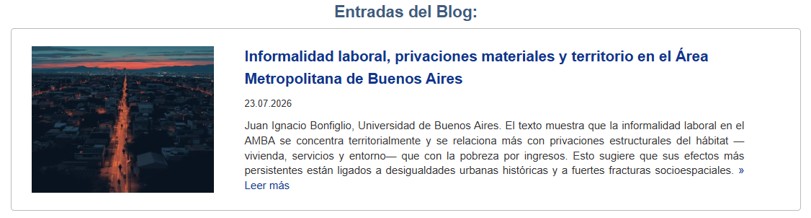
Latest INSEAI Blog post by Juan Ignacio Bonfiglio (University of Buenos Aires), exploring the territorial links between labour informality and material deprivation in the Buenos Aires Metropolitan Area.
Using highly disaggregated data from Argentina’s 2022 Population Census, the analysis shows how informal employment and material deprivation are unevenly distributed across the metropolitan space. Particularly relevant is the stronger territorial overlap between labour informality and structural housing deprivation, highlighting how labour vulnerability intersects with long-standing inequalities in housing, infrastructure and access to basic services.
Looking Ahead: Academic Networks and Conferences
With the summer period underway, July also provided a bridge towards an intensive new phase of INSEAI activities after the break.
Preparations advanced for the Third INSEAI Workshop , “Economic, Juridical and Political Frameworks and Cultural and Moral Beliefs: Informality, Socioeconomic Inequalities and Well-Being” , to be held on 26–27 November 2026 at the Faculty of Economics and Business of the University of A Coruña , in hybrid format.
The workshop will move beyond conventional quantitative indicators to explore how economic vulnerability, legal consciousness, institutional trust, political legitimacy, cultural norms, social acceptance and livelihood strategies influence informal practices. Particular attention will also be paid to qualitative and mixed methodologies capable of incorporating less directly observable dimensions into the INSEAI Model.
The call brings together perspectives from economics, law, sociology, political science, anthropology, labour and gender studies and related disciplines. Fernando González Laxe (University of A Coruña) and Rebecca Rose Nocella ( Oxford Brookes University ) are among the invited keynote speakers.
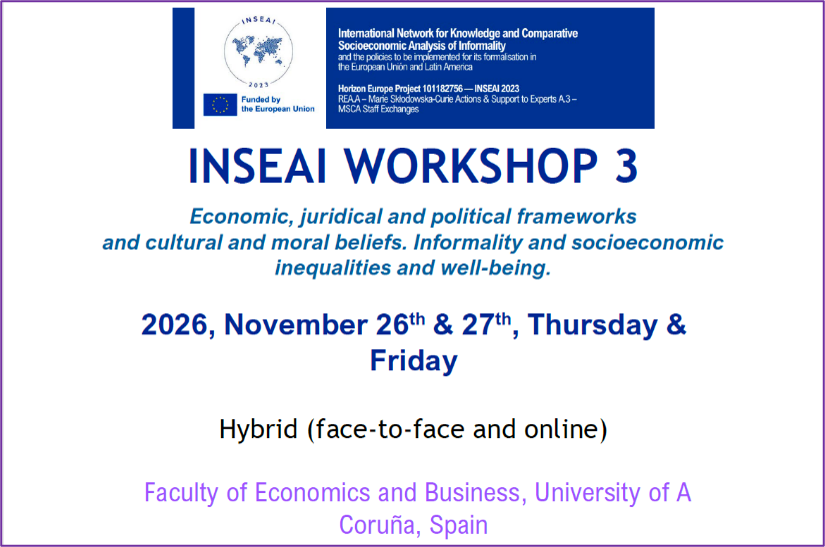
The Third INSEAI Workshop, to be held at the University of A Coruña in November 2026, will mark one of the network’s next major milestones, bringing together new perspectives on informality, socioeconomic inequalities and well-being.
The deadline for registration and abstract submission is 5 October , followed by notification of acceptance on 15 October and full-paper submission by 31 October (see call for papers)
INSEAI project signed three collaboration agreements with Universidad de la Matanza (Argentina), the Master's program in Economic Development and Public Policy, of the Autonomous University of Madrid and the Postgraduate Area in Economics of the Faculty of Economic and Administrative Sciences of the Pedagogical and Technological University of Colombia (UPTC), respectively, to promote academic collaboration and the exchange of professors and postgraduate students from the different entities of the Inseai Network and the universities that are signatories to these agreements.
Secondment Chronicle
Rediscover the magic of Galicia.
By Oana-Maria PĂSTAE, Ph.D. Associate Professor, “Constantin Brancusi” University of Targu Jiu , secondee at University of A Coruña, Spain.
Every research secondment leaves behind more than academic outputs, it also gives you a deep look into the society and culture, it lets you see daily life, talk with local people, and understand traditions.
During my stay in Galicia , hosted by the University of A Coruña , I discovered that some of the most valuable lessons about inclusion, identity and social cohesion were not found in conference rooms or libraries, but in the streets, plazas and small coastal towns where everyday life unfolds at its own rhythm. Only after wandering through its streets, did I discover a city whose identity has been shaped for centuries by the Atlantic Ocean. Nestled in the north of Galicia, keeper and key of the kingdom of Galicia, A Coruña was born from a port and a lighthouse, and it was called Brigantia, County of Lighthouse, and Crunia. The peninsula, shaped like a tree, the city makes up the trunk, its left side lined by beaches and its right side housing the marina and port while the old quartier, Cidade Vella, and the ancient Roman lighthouse, Torre de Hércules, lie within the tree’s canopy.
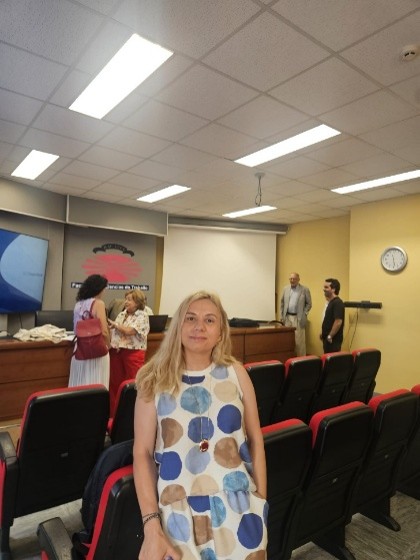
Oana-Maria Păstae attending the doctoral thesis defence of Ignacio Picatoste Novo at the University of A Coruña during her INSEAI secondment in Galicia.
I am still wondering what makes A Coruña so special and I think it is its character, so distinct from the familiar face of Spain. Coming from Romania, where life is fast, I was struck by the pace of life because Galicia invites you to slow down. Conversations are not hurried, meals are shared, neighbours greet one another in the streets and families remain at the centre of social life. I told a Spanish friend: “It is late, I have to go.” And the answer was: “It is never late.” That simple sentence stuck in my mind throughout my stay. It perfectly captured what I came to recognise as the Galician philosophy of life: there is always time for another conversation, another coffee or another walk along the Atlantic.
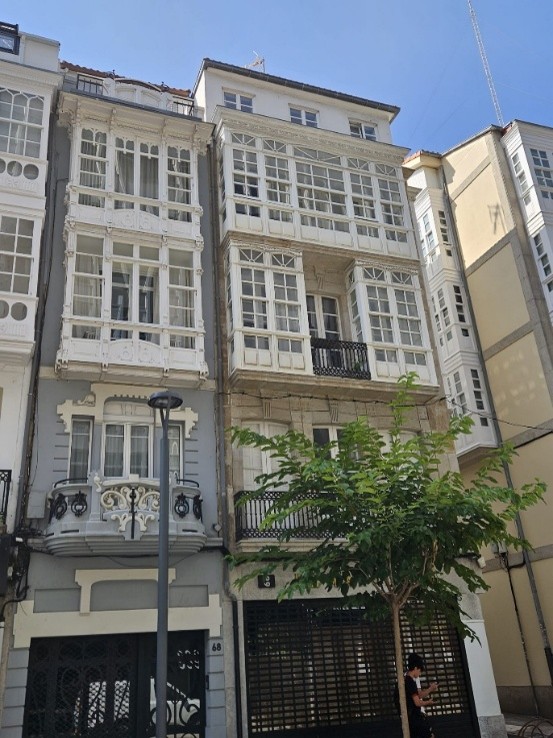
Traditional galerías in A Coruña, one of the distinctive features of the city’s Atlantic architecture encountered by Oana-Maria Păstae.
People of A Coruña are nicknamed cascarilleros, the nickname comes from the historic port trade of cocoa and the consumption of cascarilla (the thin husk of the cocoa bean), and they are social, fun-loving and proud of their city. A famous regional saying states: "Coruña se divierte, Pontevedra duerme, Vigo trabaja, Santiago reza" (Coruña has fun, Pontevedra sleeps, Vigo works, Santiago prays), portraying the residents.
Another aspect that caught my eye was the strong role of family and tradition. Grandparents remain actively involved in family life, and intergenerational bonds are visible throughout the community. It is common to see an adult child gently accompanying an elderly mother to the beach or to the Casa da Cultura, where older residents gather to play cards, share conversations and participate in social activities. During local festivals, such as LA FERIA MODERNISTA, in Sada, and the MORRIÑA FESTIVAL, in A Coruña, younger generation enthusiastically participate alongside their parents and grandparents celebrating in an atmosphere of joy and togetherness while proudly wearing costumes dating back to the early 20th century- men with linen or chino trousers, white shirts, suspenders, straw boaters, and lace-up shoes and women with long-waisted dresses, elegant hats adorned with ribbons or flowers, lace parasols, and classic Belle Époque silhouettes. The streets come alive with music, traditional dances, laughter and joy which reminds me that festivals here are celebrations of community as much as they are celebrations of culture. What struck me most was not the size of the event but the ease with which families shared the experience. This reflects not only respect for older people but also their continued inclusion in family and community life, where ageing is embraced as a natural and valued stage of life rather than a period of social isolation.
I found myself relating this everyday experience to the themes of the INSEAI project. Research on labour-market informality often focuses on institutions, regulations and economic indicators, yet, Galicia reminded me that successful labour-market integration also depends on something less tangible: trust, communication, social networks and a genuine sense of belonging.
I could not find tourist traps here, most people I encountered were Galicians because the city keeps a strong local character rather than feeling built around visitors. Why? Maybe because many foreigners head straight to Santiago de Compostela which is the destination of the Camino de Santiago or others choose The Balearic Islands. It could also be due to its climate which attracts a different type of tourist because the weather here is milder and less predictable than southern Spain. Unlike the flamenco rhythms or bullfighting spectacles that characterise other regions of Spain, Galicia offers bagpipes, mythical folklore, festivals and rituals that draw a line straight back to Celtic origins.
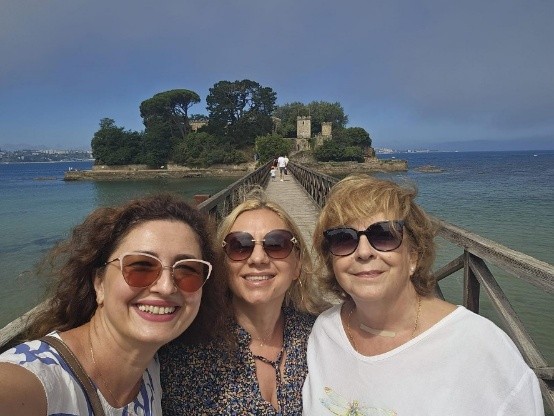
Oana-Maria Păstae, Diana Mihaela Țîrcă (University of Bucarest, old INSEAI member) with María Isabel Novo-Corti (University of A Coruña) at the Castle of Santa Cruz, Oleiros, during Oana secondment in Galicia.
The local cuisine quickly became another way of understanding Galicia. To fuel my wanderings, I did as the Spanish do, I grabbed a coffee at one of the city’s many cafés, a tarta de Santiago, an almond cake, Lapardilla and the best churros and hot chocolate since 1932 at Bonilla a la Vista. I also popped into a bakery for an empanada or a bocadillo and I tried raciones, croquetas (croquettes) or filete empanado con patatas y pimiento (fried steak with potatoes and pepper), but a must-try from the sea included pulpo á feira (octopus with paprika, salt and olive oil), vieiras (scallops), and berberechos (cockles). Every lunch or dinner became less about eating and more about conversation and togetherness here in Galicia.
Looking to burn off a few of those calories, I took a stroll on the paseo marítimo, a 13 km long seaside promenade, climbed to the top of Monte San Pedro for the best views of the city and the surrounding landscape and had a walk to the Tower of Hercules, the world's oldest working Roman lighthouse. This 55-metre-high Roman lighthouse has been guiding ships uninterrupted for nearly 2000 years. As a UNESCO World Heritage site, it houses 234 steps, each one taking you further back in time.
There are beautiful places to go for a walk in this beautiful city just as Los Cantones or El Obelisco. Here was the area called La Pescadería where inhabitants of A Coruña fought against the English army in 1589 to defend their city. One of A Coruña's greatest advantages is its golden sands, just a 5-minute walk from the city centre. The Riazor and Orzán beaches form a continuous 1.4-kilometre stretch of coastline. A Coruña's Old Town (Ciudad Vieja) is a gateway to the past, with its narrow cobblestone streets, medieval churches, and tranquil squares. The Plaza de María Pita is the heart of the city, home to the statue of the local heroine María Pita, who defended the city against Sir Francis Drake's attack in 1589 and to the Palacio Municipal, which dates from the beginning of the present century. I was impressed by The Picasso Museum which offers an interesting collection documenting the years the artist spent in A Coruña as a child. There’s also another thing about A Coruña that I just can’t shake- The Ventana al Atlántico (Window to the Atlantic), located in the O Portiño area, a rustic, megalith-style white granite sculpture made by artist Francisco Pazos Martínez in 2004 that looks like an open window facing the ocean and where you can look through the stone cut-outs towards the ocean waves and admire the sun sink into the Atlantic as the city lights slowly begin to twinkle on.
My secondment in A Coruña has therefore been much more than an academic mobility, it has been an opportunity to observe how cultural heritage, community participation and social cohesion contribute to people’s well-being. Galicia has reminded me that successful societies are built not only through economic development, but also through strong communities, shared values and deeper human connections.
Cultural Corner: Recommended Reading
Indian Business, Economic Development, and the Jobs Dilemma in the Twenty-First Century .
Anthony P. D’Costa. Oxford University Press, 2026.
This forthcoming book offers a timely perspective on one of the central tensions of contemporary economic development: how economic transformation and business expansion translate — or fail to translate — into sufficient and meaningful employment.
Focusing on India, the book provides an opportunity to look beyond the European Latin American comparison that usually structures INSEAI’s work and consider similar questions from another major emerging economy. The relationship between productive transformation, employment creation and the quality of work makes it particularly relevant to broader debates on labour-market segmentation and inclusive development.
A useful summer reading for widening the geographical lens through which we think about employment, development and the changing organisation of work.
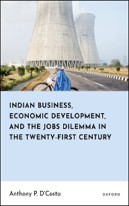
A timely perspective on economic development, business transformation and the challenge of creating meaningful employment in India.
Contact & Stay Connected
Website: www.inseai.eu
Email: info@inseai.eu
LinkedIn: https://www.linkedin.com/in/inseai-project-471875371
Instagram: https://www.instagram.com/inseai.project/
Facebook: https://www.facebook.com/people/Inseai/61576239562950/
YouTube: https://www.youtube.com/@INSEAI-PROJECT
Spotify: https://open.spotify.com/
Calendar l Upcoming Events: https://www.inseai.eu/es/eventos
- Newsletter Team: Matías Membiela-Pollán (Coord.), UDC, Xose Picatoste-Novo, UDC, and Sandrina Teixeira (IPP).

International Network for Knowledge and Comparative Socioeconomic Analysis of Informality and the Policies to be Implemented for their Formalization in the European Union and Latin America
Horizon Europe Project 101182756 — INSEAI 2023