

INSEAI Newsletter - May 2026
Project & Network Highlights l May 2026
May was marked by an intense programme of academic exchange, secondments and dissemination activities across the INSEAI network . Researchers continued to strengthen collaboration between Europe and Latin America through lectures, discussions, institutional visits and outreach initiatives.
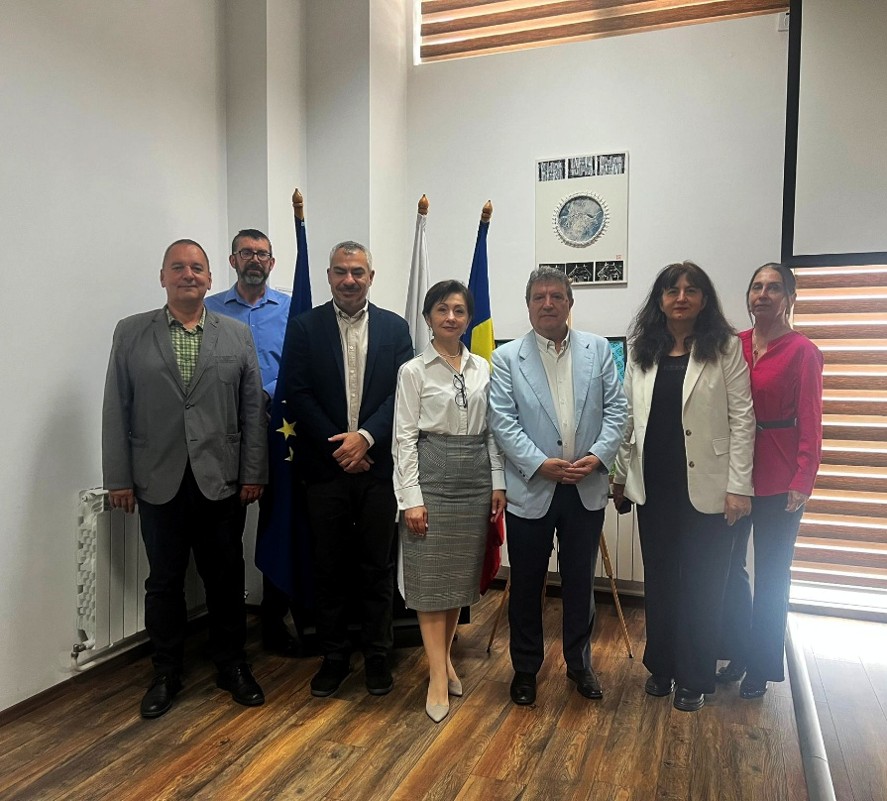
Santos Ruesga, INSEAI Project Coordinator, and Julimar da Silva (UAM) together with academic representatives of Constantin Brâncuși University of Târgu Jiu (Romania), during a meeting aimed at strengthening international cooperation and fostering new collaborative research initiatives within the network.
Particular attention was given to the relationship between digitalisation and labour informality, public policies addressing informal employment, and the role of the State in shaping labour-market inclusion. The month also saw the release of new episodes of both the INSEAI Testimony Collection and Informal Talks, alongside new contributions to the INSEAI Blog.
At the institutional level, Santos Ruesga and Julimar da Silva visited partner universities in Romania, while new secondments began, including the stay of researchers from Universidade da Coruña at ISCAP Porto.
Network Cooperation: Learning and debating across universities
International cooperation continued to expand throughout May.
A significant milestone was the visit of Santos Ruesga and Julimar da Silva to Romania, where they met with researchers and institutional representatives from the University of Bucharest and Constantin Brâncuși University of Târgu Jiu . These meetings reviewed the progress of ongoing activities and explored future opportunities for collaboration, strengthening the network’s presence in Eastern Europe and reinforcing cooperation among beneficiary institutions.
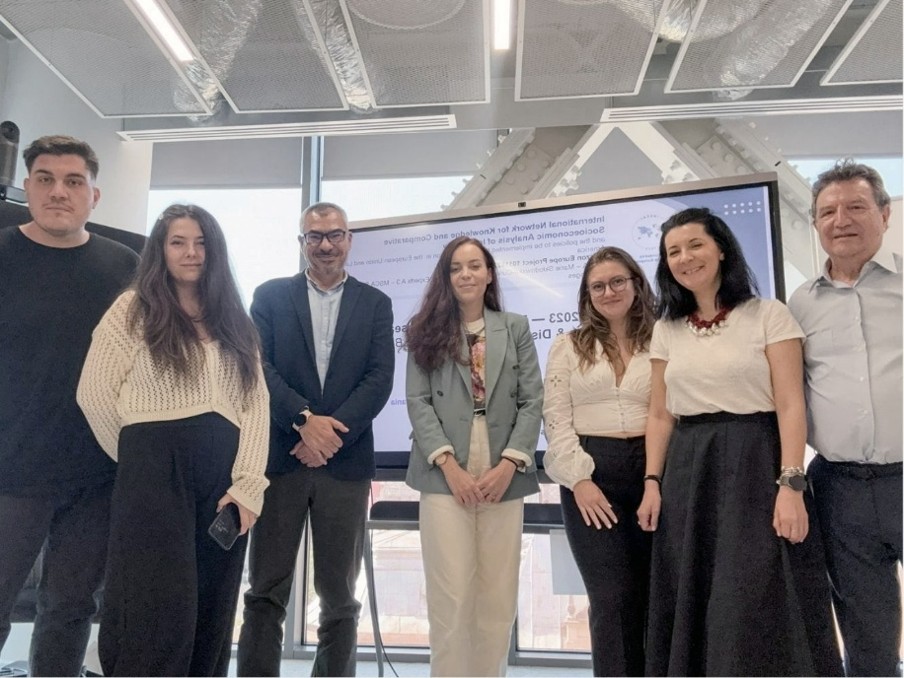
Santos Ruesga and Julimar da Silva (UAM) during a working session in University of Bucharest (Romania).
Academic mobility also remained central to the project. On 21 May, a new secondment began at ISCAP Porto , welcoming María Isabel Novo-Corti, Xosé Picatoste, Matías Membiela Pollán and Francisco José Rey Vozoso from Universidade da Coruña.
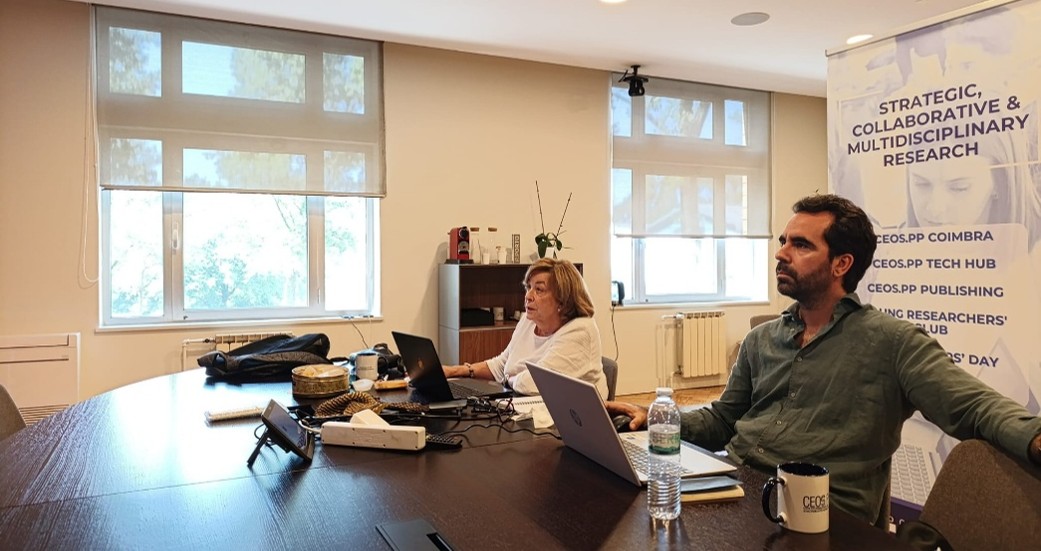
Isabel Novo-Corti and Francisco Rey Vozoso (Universidade da Coruña) during their secondment at ISCAP – Polytechnic Institute of Porto, contributing to collaborative research activities within the INSEAI network.
The network also continued refining its communication strategy. Following recommendations received during the Mid-Term Meeting, updated visual identity materials and templates were made available to all members, ensuring consistency across future dissemination activities.
Discussion Series
May's academic programme combined discussions and lectures addressing labour informality from institutional, technological and policy perspectives.
Silvana Galeano Alfonso ( University of Buenos Aires-CONICET ), currently on secondment at UAM, presented research on digital technologies, digital skills and labour outcomes among young workers in Buenos Aires. Coordinated by Santos Ruesga and Julimar da Silva, the session examined how class, gender and labour-market formality influence access to digital opportunities, highlighting persistent inequalities in increasingly digitalised labour markets.
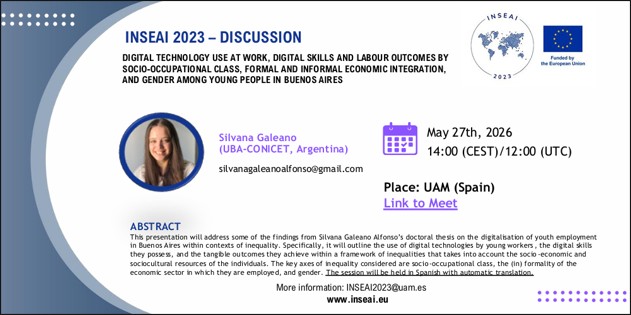
Poster of the INSEAI Discussion delivered by Silvana Galeano Alfonso (UBA–CONICET, Argentina), examining how digital technologies, digital skills and social inequalities shape labour outcomes among young people in Buenos Aires.
The programme also included a lecture by Natividad González and Agustina Romero ( National University of Jujuy ), currently undertaking research stays at the University of Alicante and Universidade da Coruña respectively. Their presentation explored the relationship between the State, employment and the informal sector in Jujuy, analysing labour regulations, trajectories and mechanisms of inclusion and exclusion. The activity was coordinated by Julimar da Silva, Víctor Climent and Isabel Novo-Corti.
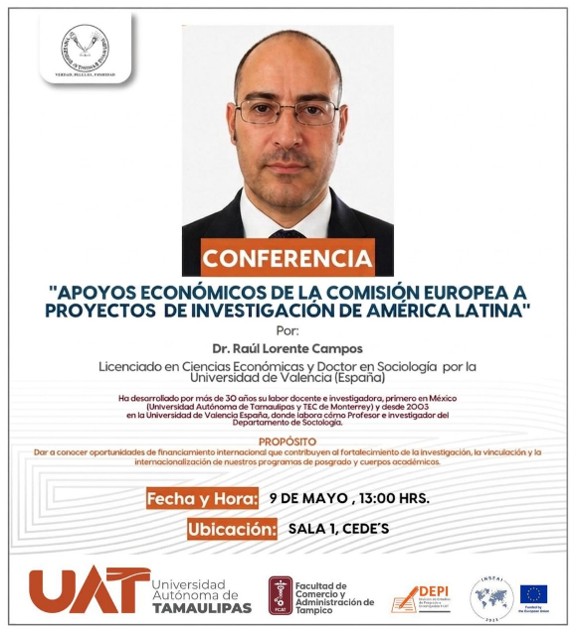
Poster of the conference delivered by Raúl Lorente Campos (Universitat de València) at the Universidad Autónoma de Tamaulipas (Mexico), presenting European Commission funding opportunities and research cooperation programmes for Latin American institutions.
Academic exchange further extended to Mexico, where Raúl Lorente (Universitat de València), during his secondment at the Instituto Belisario Domínguez, delivered several lectures and conferences, including Labour Informality as a Chronic Problem of Latin American Labour Markets and a presentation on European Union support programmes for research projects in Latin America.
INSEAI: Blog & Testimonies
May also brought new dissemination activities across the network.
A new episode of the INSEAI Testimony Collection featured Raúl Lorente (Universitat de València), who reflected on the persistence of labour informality in Spain and discussed some of the challenges associated with precarious employment, underemployment and labour-market segmentation.
The latest episode of Informal Talks welcomed María Ángeles Durán , one of Spain’s leading sociologists and a pioneering scholar in the study of unpaid work and the care economy. The conversation explored the economic and social value of domestic and care work, highlighting their often-invisible contribution to social reproduction and well-being.
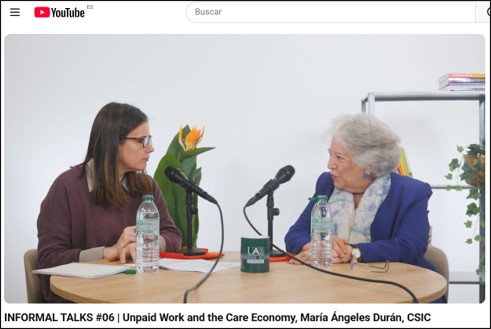
María Ángeles Durán (CSIC) during the latest episode of Informal Talks , reflecting on unpaid work and the care economy.
The INSEAI Blog also published new content during the month. A contribution by Cristian Castillo, María Moyano and Emma Ávila (DESH Consultores, Colombia) examined labour informality in contexts of migration and displacement, analysing how mobility processes can intensify labour vulnerability and exclusion. Readers were also invited to revisit Labour Informality in Economic Thought, by Shirley Benavides Vindas (Universidad Nacional de Costa Rica), which reviews the evolution of economic perspectives on informality from classical approaches to contemporary structural analyses.
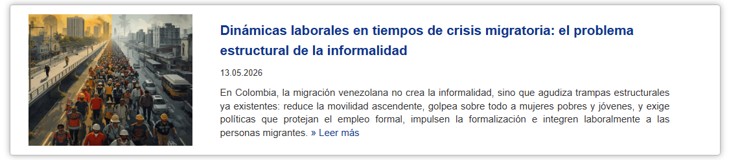
Post on the INSEAI Blog examining how migration crises can reinforce existing patterns of labour informality, focusing on the challenges of labour-market integration and social protection in Colombia.
Secondment Chronicle
Comparing Labour Markets Across the Atlantic: Experiences from Argentina
During March and April, Empar Aguado and Josep V. Pitxer (Universitat de València) carried out a research stay at the Pontifical Catholic University of Argentina (UCA) within the framework of the INSEAI network.
The stay provided an opportunity to compare labour-market institutions, employment policies and patterns of informality in Argentina and Spain. Academic exchanges focused particularly on unemployment, labour-market segmentation, precarious employment and the barriers limiting the formalisation of domestic and care work.
Beyond the specific research activities, the experience reinforced cooperation between institutions and contributed to a broader comparative understanding of labour-market challenges shared across both regions. Through seminars, lectures and discussions with researchers from UCA and the Argentine Social Debt Observatory, the secondment generated new opportunities for collaborative research while strengthening the international dimension of the network.
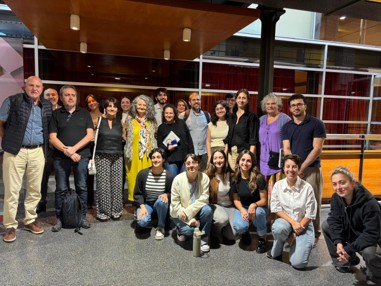
Empar Aguado and Josep V. Pitxer (Universitat de València) together with researchers, students and collaborators at the Pontifical Catholic University of Argentina (UCA), during their INSEAI secondment focused on labour markets, public policies and informality.
Cultural Corner: Recommended Reading
Nickel and Dimed: On (Not) Getting By in America . Barbara Ehrenreich ( Henry Holt & Company Inc, 2001 ).
In this classic work of immersive journalism, Barbara Ehrenreich leaves behind her academic life and takes a series of low-paid jobs as a waitress, cleaner and retail worker across the United States. Her aim is simple: to discover whether it is possible to survive on the wages earned by millions of workers.
The result is a vivid account of economic insecurity, precarious employment and the everyday struggles faced by workers at the margins of prosperity. Although written more than two decades ago, the book remains highly relevant for understanding the realities of vulnerable labour markets, informal survival strategies and the limits of employment as a guarantee against poverty.
A compelling reminder that behind labour-market statistics there are real lives, complex choices and persistent challenges of dignity and social inclusion.

Barbara Ehrenreich’s Nickel and Dimed (2001), a powerful account of precarious work and economic survival in contemporary labour markets.
Contact & Stay Connected
Website: www.inseai.eu
Email: newsletter@inseai.eu
LinkedIn: https://www.linkedin.com/in/inseai-project-471875371
Instagram: https://www.instagram.com/inseai.project/
Facebook: https://www.facebook.com/people/Inseai/61576239562950/
YouTube: https://www.youtube.com/@INSEAI-PROJECT
Spotify: https://open.spotify.com/
Calendar l Upcoming Events: https://www.inseai.eu/es/eventos
Newsletter: newsletter@inseai.eu
- Newsletter Team: Matías Membiela-Pollán (Coord.), Xose Picatoste-Novo, Sandrina Teixeira

International Network for Knowledge and Comparative Socioeconomic Analysis of Informality and the Policies to be Implemented for their Formalization in the European Union and Latin America
Horizon Europe Project 101182756 — INSEAI 2023