
INSEAI Newsletter 2026/2 - February
Project & Network Highlights l February 2026
February consolidated the second year of the INSEAI project with an intense programme of lectures, discussions and secondment activities across Europe and Latin America. Alongside academic exchange, the month brought relevant operational updates, including the launch of a new PUBLICATIONS section on the INSEAI website and continued efforts to strengthen participation in the Employment and Informal Earnings Survey.
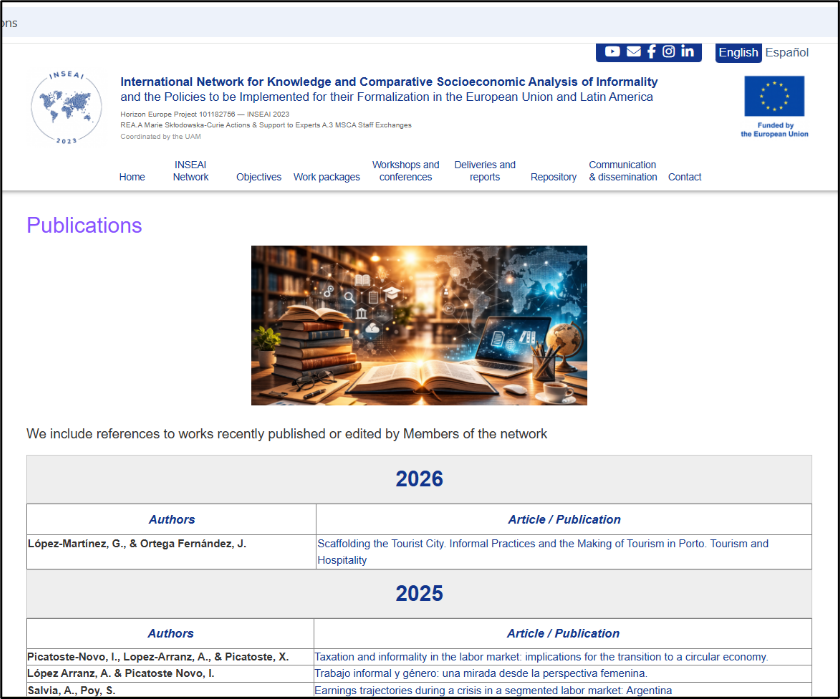
Launch of the new Publications section on the INSEAI website, bringing together recent articles, books and research outputs produced by members of the network.
This issue also introduces a new section — Secondment Chronicle — aimed at giving greater visibility to the research outputs, institutional exchanges and collaborative dynamics generated through mobility activities. As secondments are a central methodological pillar of INSEAI, this new feature will regularly highlight their academic and institutional impact.
Network Cooperation: Learning and debating across universities
Research during February addressed structural dimensions of informality, labour precarity, migration, gender, care economy and psychological distress, reinforcing the project’s multidisciplinary and comparative approach.
February featured strong institutional cooperation through seminars, lectures and secondment-based exchanges across partner universities.
At the Universitat de València , the International INSEAI Seminar Cycle brought together network members to discuss complex-systems approaches to informality, methodological proposals for measuring the popular economy in Argentina and Jujuy, and public policies linking informality and early childhood care in Paraguay.
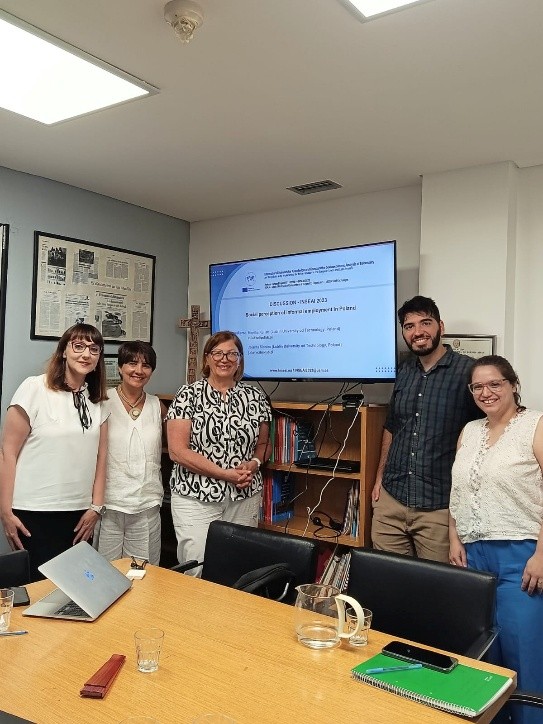
At ODSA–UCA (Argentina) , the research stay of Monika Kulisz and Jolanta Słoniec (Lublin University of Technology, Poland) included two exchange sessions: one open to the full INSEAI network and another dedicated to comparative analysis of economic-occupational indicators between Poland and Argentina. These meetings strengthened dialogue on social perceptions of informality and comparative measurement strategies.
|
At ODSA–UCA (Argentina), Monika Kulisz and Jolanta Słoniec (Lublin University of Technology, Poland) during their research stay, presenting their work on social perceptions of informal employment and engaging in comparative dialogue with the local team. |
Meanwhile, at the University of Salerno (Italy) , researchers from UCA and Universidad de Jujuy advanced empirical work on labour informality, submitted abstracts to international conferences and calls for chapters, conducted qualitative interviews, and delivered a seminar for faculty and students on the use of artificial intelligence in research. These activities combined academic production, methodological training and institutional collaboration.
The Letter from the Coordinator (23 February 2026) announced the creation of a new PUBLICATIONS window on the INSEAI website. This space will compile articles, books, chapters and audiovisual outputs produced within the framework of the project. Members are encouraged to submit references to recent works and to explicitly acknowledge that outputs are carried out within Project 101182756 — INSEAI 2023 (MSCA Staff Exchanges). The Letter also reiterated the protocol for recording public meetings and renewed the call to intensify dissemination of the Employment and Informal Earnings Survey.
The project enters its second year with the launch of Work Package 3 , coordinated by Prof. Isabel Novo at University of A Coruña (UDC) . WP3 focuses on the compilation of socioeconomic values and beliefs, and policy and institutional frameworks at national and international levels . Teams are encouraged to incorporate WP3 tasks into secondment work plans, aligning research stays with this thematic framework.
Discussion Series
February’s Discussion Series reflected the breadth of INSEAI’s comparative agenda, with sessions closely linked to ongoing secondments and cross-regional collaboration.
Several discussions focused on Argentina , examining labour informality from complementary perspectives. Contributions from researchers at the Argentine Social Debt Observatory (UCA), currently on secondment at UNISA, combined methodological updates in the measurement of informality with comparative evidence on youth labour-market trajectories and the psychological effects of precarious employment. In parallel, Diego Masello (ITRAS – Universidad Nacional de Tres de Febrero), on secondment in Spain, addressed the structural economic weight of informality in Argentina, analysing productivity gaps and the implications for public policy design.
The relationship between informality, gender and technology was also central this month. During a secondment at UCB-IISEC (Bolivia), colleagues from Instituto Politécnico de Porto explored how women artisans engaged in informal work negotiate digital tools and online markets. Drawing on qualitative interviews, the discussion highlighted both new opportunities for visibility and persistent structural barriers linked to gender roles, literacy and access to technology.
Comparative analysis extended to Central and Eastern Europe , where Monika Kulisz and Jolanta Słoniec ( Lublin University of Technology ), on secondment at UCA (Argentina), presented a segmentation-based study on social perceptions of informal employment in Poland. Their research identified distinct profiles of informality, showing how contract arrangements, undeclared work experiences and social attitudes shape labour practices.
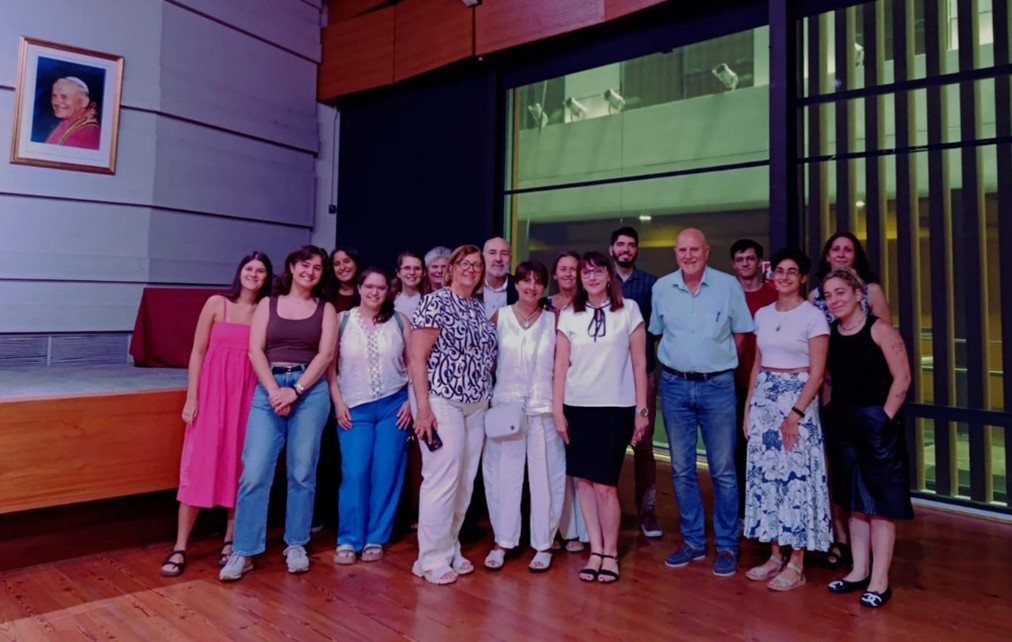
Strengthening comparative perspectives between Latin America and Central and Eastern Europe, Monika Kulisz and Jolanta Słoniec shared their segmentation-based research on social perceptions of informal employment in Poland, highlighting how contract types, undeclared work and societal attitudes shape diverse informality profiles.
The social consequences of informality were further explored through research on the care economy in Paraguay , presented by Marcela Achinelli (Universidad Nacional de Asunción) during her secondment at UVEG. The session linked demographic change and labour-market participation with the cultural recognition of care work as a central policy challenge.
Finally, a webinar delivered by María Agustina Paternó Manavella (ODSA-UCA), currently on secondment at UNISA, examined the rising trend of psychological distress in Argentina between 2010 and 2025. Drawing on EDSA data, the study highlighted the significant increase in distress levels over the past decade, particularly among individuals in precarious labour conditions. Female gender, unemployment and poor self-rated health emerged as consistent predictors, reinforcing the connection between structural socioeconomic instability and mental well-being.
INSEAI: Blog & Testimonies
February expanded INSEAI’s audiovisual outreach.
The INSEAI Testimony Collection released new episodes featuring:
- Shirley Benavides (Universidad Nacional de Costa Rica – UNA)
- Carlos Recuay (Universidad Nacional Mayor de San Marcos – Peru)
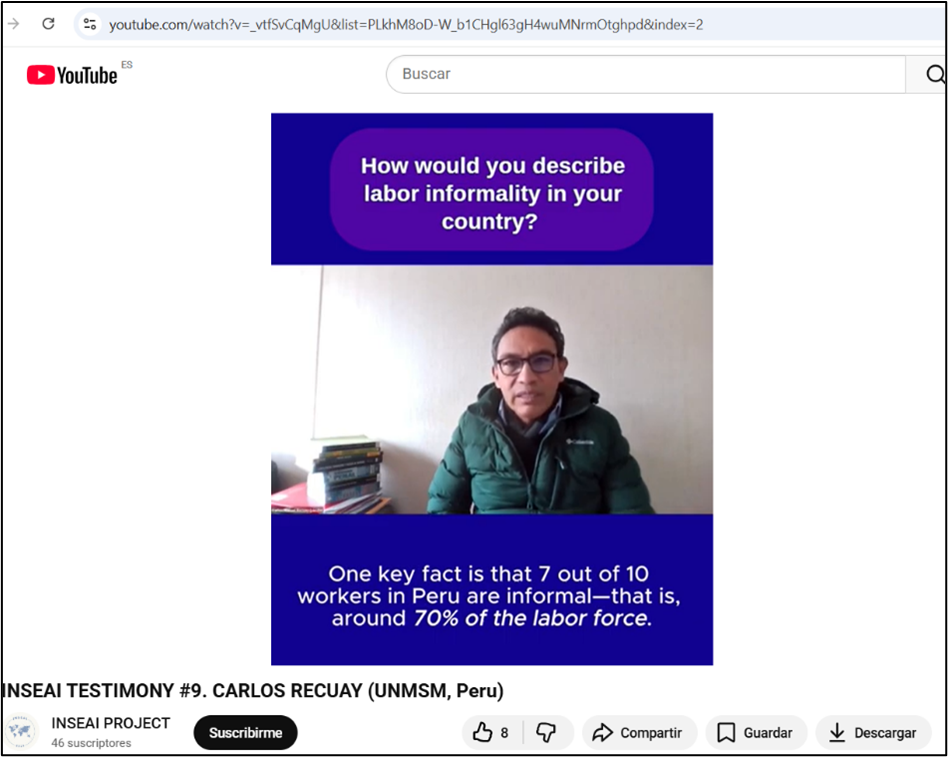
INSEAI Testimony #9 features Carlos Recuay (UNMSM, Peru), reflecting on the scale and structural roots of labour informality in Peru, where nearly 70% of the workforce operates in informal conditions.
Both testimonies provide national perspectives on informality and labour governance, complementing the network’s comparative research agenda.
A new episode of INFORMAL TALKS , the INSEAI podcast, featured Shirley Benavides and María Leonela Artavia, who reflected on digital labour platforms, trade unions and the challenges of achieving a fair technological transition.
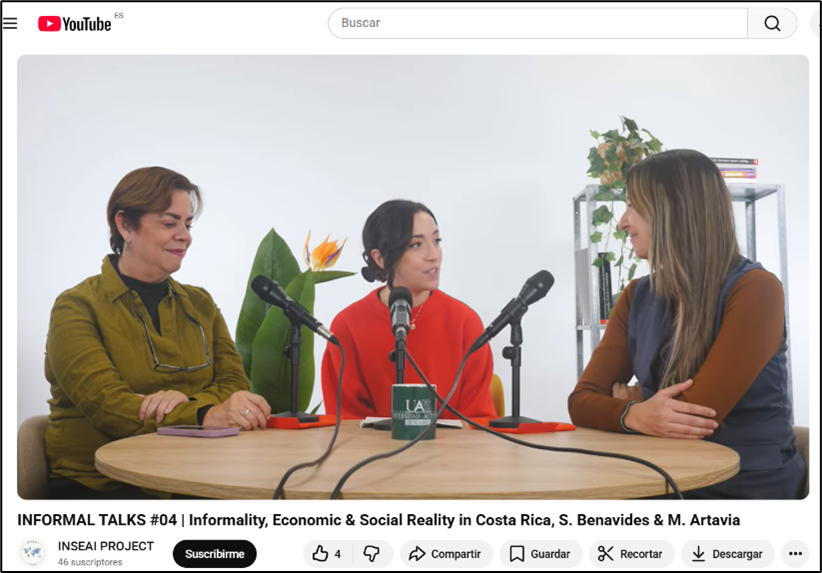
INFORMAL TALKS #04 brings together Shirley Benavides and María Leonela Artavia to discuss labour informality in Costa Rica, exploring its economic, social and institutional dimensions within contemporary labour markets.
February also brought new analytical reflections to the INSEAI Blog .
On 16 February, Agustín Salvia (CONICET–UBA–UCA) published “Old Informalities, New Economies: Structural Analogies of Informal Work in Contexts of Transition” . The post revisits labour informality from a structural perspective, using Argentina as an illustrative case for middle-income economies. It argues that informality should not be seen as a residual phenomenon linked only to underdevelopment, but as a functional component of growth models marked by productive heterogeneity.
The contribution highlights continuities between traditional urban informality and contemporary precarious or digitalized work, stressing recurring patterns such as income instability, weak social protection and individualized risk. The Argentine experience serves to question the assumption that employment alone guarantees social integration, opening the debate on new forms of labour and social protection in contexts of persistent structural inequality.
Looking Ahead: Academic Networks and Conferences
Preparations are underway for the INSEAI Mid-Term Meeting (11 March 2026) , where progress, challenges and strategic planning for the coming years will be reviewed, including a dedicated session between seconded staff and the EU officer.
The deadline for submissions to the Second INSEAI Workshop , to be held at the University of Salerno in hybrid format, is 15 March 2026 . Members are encouraged to participate actively and circulate the call widely.
WP3 activities continue to advance, aligning secondments and research outputs with the compilation of socioeconomic values, institutional frameworks and comparative policy analysis.
Secondment Chronicle

The Rising Trend of Psychological Distress in Argentina: Assessing Structural Determinants
María Agustina Paternó Manavella (ODSA-UCA PhD Fellow on Secondment at UNISA)
(Reduced version for the Newsletter)
Mental health, commonly assessed through indicators of anxiety and depressive symptoms, has become an increasingly important lens for understanding the social consequences of economic instability. Psychological distress — measured through the integration of depression- and anxiety-related symptoms — captures emotional suffering that may manifest as sadness, hopelessness, tension, fatigue or insomnia. Crucially, research shows that this indicator is highly sensitive to structural conditions such as poverty, job insecurity and social exclusion.
Within the Human Capital and Well-being area at ODSA-UCA, this study estimates annual trends in psychological distress among urban adults in Argentina between 2010 and 2025. It also examines incidence, mobility and persistence of distress, with particular attention to labour market conditions as structural determinants.
The analysis draws on annual data (2010–2025) from the Argentine Social Debt Survey (EDSA), a representative survey of adults in urban households. In addition to cross-sectional analysis, the research incorporates a three-wave panel (2022–2024, n=299), enabling longitudinal examination of individual trajectories.
Psychological distress is measured using the Kessler Psychological Distress Scale (K-10), a validated instrument widely used in epidemiological research. The scale consists of 10 items assessing anxiety and depressive symptoms experienced in the past 30 days, allowing both continuous measurement and categorical identification of distress severity.
The methodological strategy combines descriptive analysis of long-term trends, trajectory analysis using panel data, and multilevel and fixed-effects models. These approaches allow the identification of intra-individual variation while controlling for time-invariant characteristics, highlighting how gender inequalities and labour market configurations shape mental health outcomes.
Results indicate that psychological distress rose from 18.4% in 2010 to 28.1% in 2024, affecting nearly three out of ten adults. Although a slight decline is observed in 2025, levels remain historically high. Distress increased across all social strata but is three times higher among individuals in precarious economic and labour market conditions.
Longitudinal evidence (2022–2024) shows that 18% of adults experienced a decline in mental health by 2024, while 5% suffered persistent symptoms throughout the three-year period. The sharpest increase occurred between 2023 and 2024, particularly among individuals with already elevated baseline levels. Poor self-rated health, female gender and unemployment emerge as consistent predictors.
These findings underline that mental health functions as a sensitive indicator of socioeconomic and labour stability. Addressing psychological distress therefore requires integrating social, economic and labour dimensions into public policy design. The use of standardized instruments such as the K-10 also enables meaningful comparative analysis between Latin American and European contexts, reinforcing the value of cross-regional research within the INSEAI framework.
Cultural Corner: Recommended Reading
The Age of Insecurity: Coming Together as Things Fall Apart
(Astra Taylor, 2023, CBC Massey Lectures).
Although not exclusively about informality, this recent essay by Astra Taylor offers a powerful lens through which to understand it. The book explores how insecurity has become a defining condition of contemporary life — from precarious work and unstable incomes to fragile social protections and weakened collective institutions.
Taylor argues that economic vulnerability is no longer confined to the margins but increasingly shapes mainstream labour markets. In this sense, informal work and precarious employment are not anomalies but structural expressions of a broader transformation of capitalism.
Written in an accessible yet analytically sharp style, the book connects labour precarity, debt, digital platforms and social fragmentation, making it a stimulating read for those interested in the wider social context in which informality expands.
A thought-provoking complement to more technical research on labour markets and formalisation policies.
Astra Taylor, The Age of Insecurity (2023). A sharp and accessible reflection on precarity, unstable work and the broader climate of insecurity shaping today’s labour markets.
Contact & Stay Connected
Website: www.inseai.eu
Email: newsletter@inseai.eu
LinkedIn: https://www.linkedin.com/in/inseai-project-471875371
Instagram: https://www.instagram.com/inseai.project/
Facebook: https://www.facebook.com/people/Inseai/61576239562950/
YouTube: https://www.youtube.com/@INSEAI-PROJECT
Spotify: https://open.spotify.com/
Calendar l Upcoming Events: https://www.inseai.eu/es/eventos
Newsletter: newsletter@inseai.eu
- Newsletter Team: Matías Membiela-Pollán (Coord.), Xose Picatoste-Novo, Sandrina Teixeira.

International Network for Knowledge and Comparative Socioeconomic Analysis of Informality and the Policies to be Implemented for their Formalization in the European Union and Latin America
Horizon Europe Project 101182756 — INSEAI 2023