

Old Informalities, New Economies: Structural Analogies of Informal Work in Contexts of Transition. The Argentine Case as an Illustrative Experience in Middle-Income Economies (2026/2)
Agustín Salvia (CONICET – UBA – UCA)
Recent transformations in the world of work—driven by digitalization, the flexibilization of labor relations, and the reorganization of productive processes—have revived longstanding debates on labor informality. Far from disappearing with economic modernization, informality persists and takes on new forms, compelling a rethinking of its causes, functions, and social consequences. In this context, the paper presented at the seminar “Informal Work and Its Analogies. Keys to Characterizing Social Structure” advances a structural reading of the phenomenon, aimed at identifying deep continuities between historical forms of informality and contemporary modes of precarious labor insertion.
One of the most persistent limitations of conventional approaches lies in the near-exclusive association between informality and underdevelopment, incomplete transition, or short-term institutional deficits. From this perspective, informality is understood as a residual phenomenon expected to decline as economic growth, productive formalization, and state consolidation advance. However, empirical evidence shows that informality not only persists, but may even expand in contexts marked by modernization, technological innovation, and organizational change.
Revisiting informality from a structural perspective entails recognizing it as a functional component of certain growth models, particularly in economies characterized by high levels of productive heterogeneity. In such contexts, informality plays a specific role: absorbing surplus labor, reducing labor costs, enabling flexible productive organization, and sustaining employment levels that could not be maintained under fully regulated schemes. Informality thus does not represent a marginal dysfunction, but rather a form of subordinated integration that articulates—unevenly—with the most dynamic segments of the economy.
From the standpoint of labor sociology and structuralist approaches to development (ILO–ECLAC), this persistence has been interpreted as the outcome of structural mismatches between productive dynamics, institutional frameworks, and systems of social protection. In middle-income economies, employment expansion does not necessarily translate into decent work or full social integration, giving rise to hybrid configurations in which productive modernization coexists with labor precarization. In this sense, informality reflects not only regulatory or enforcement failures, but also the limits of development models that generate employment without guaranteeing rights, protection, or stability—thereby challenging the traditional capacities of labor and social policy to foster sustained inclusion.
This approach shifts attention away from the visible forms of informal work toward the structural logics that organize labor relations. Both in classical urban informality and in newer forms of flexible, autonomous, or digitalized work, similar patterns tend to reappear: income instability, weak or absent social protection, limited collective bargaining power, and the individualization of risk. These continuities are not determined by the type of activity or the degree of technological sophistication, but by the structural position workers occupy within the productive system.
Although new forms of informality adopt diverse formats—ranging from traditional urban commerce to occupations mediated by digital technologies—the underlying logic remains comparable. In both cases, workers bear the costs of production, manage their own social reproduction individually, and face asymmetric relationships vis-à-vis the actors who organize or intermediate labor. The analytical focus, therefore, should not rest on the specific form employment takes, but rather on the social relations that structure it and on the mechanisms of precarization these relations reproduce.
The Argentine case is particularly illustrative for examining these dynamics. As a middle-income economy, Argentina displays a long-standing trajectory of productive heterogeneity and a high incidence of labor informality, even during periods of economic growth. This pattern cannot be explained solely by cyclical crises, but is deeply rooted in the productive structure and in the ways labor markets, social protection systems, and the state are articulated.
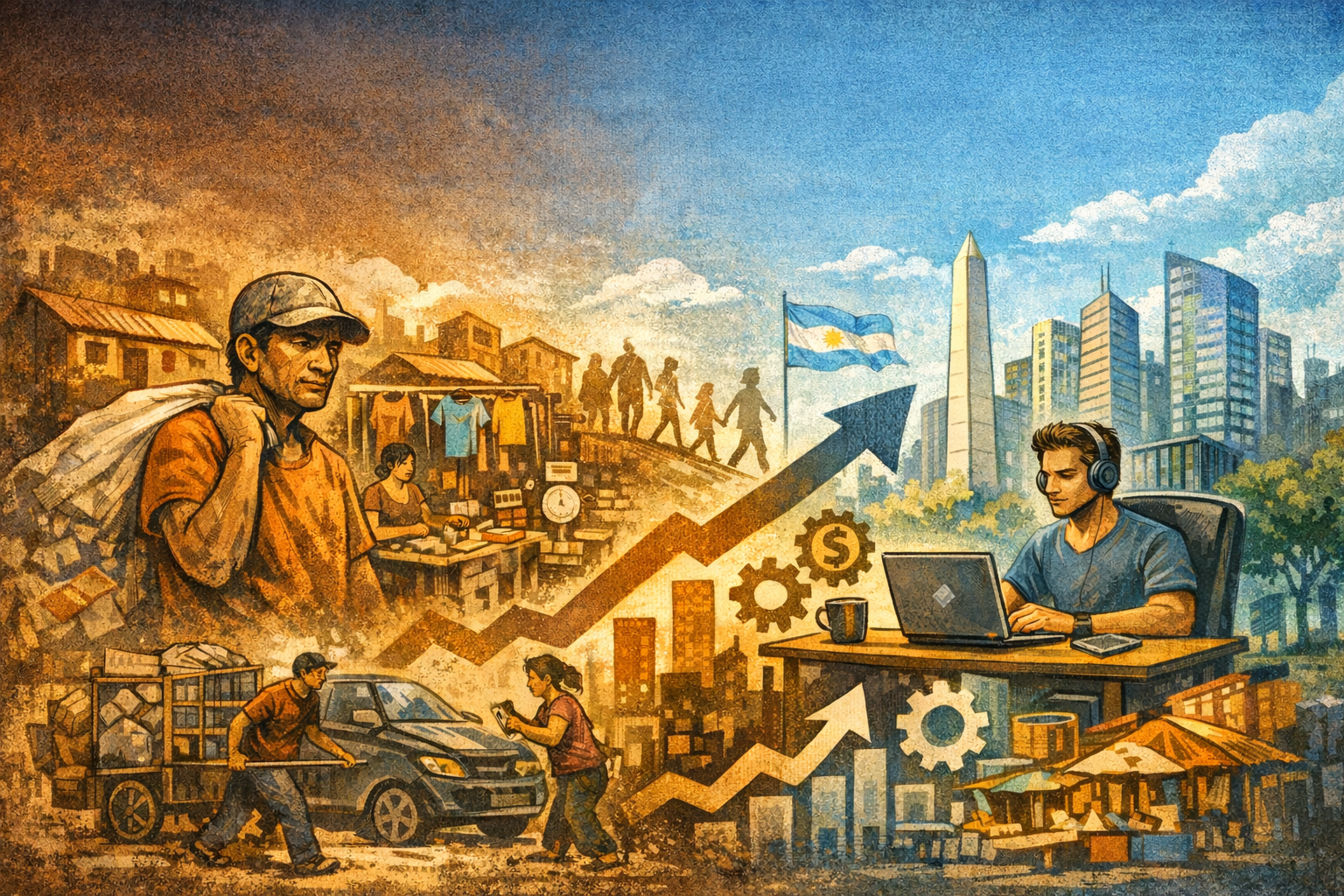
Over recent decades, Argentina’s labor market has undergone simultaneous processes of modernization and precarization. While certain sectors incorporated digital technologies and new organizational forms, broad segments of the workforce remained in—or entered into—occupations marked by instability and the absence of labor rights. The expansion of digitally mediated forms of work did not substantially alter this logic; on the contrary, it tended to reproduce pre-existing segmentations, distinguishing between relatively stable digitalized jobs and others that function as subsistence strategies.
Analyzing the Argentine case as a historical experience makes it possible to show that these dynamics are not exceptional, but rather representative of broader tensions present across many economies in transition. In this sense, the relevance of the case lies not in its singularity, but in its capacity to reveal the limits of labor integration models based almost exclusively on employment as the main pathway to social citizenship.
One of the central findings of this approach is the growing dissociation between employment and social integration. Having a job no longer necessarily guarantees stability, protection, or social recognition. Under conditions of structural informality, large segments of workers participate in the labor market without access to the rights and securities historically associated with formal employment, posing profound challenges for social protection systems and traditional labor policies.
The prospective conclusion situates informality within the framework of unfinished transitions. Middle-income economies face the challenge of redefining their models of integration in a context marked by employment fragmentation and the erosion of classical protections. The key question is no longer merely how to reduce informality, but what forms of labor and social integration are viable under conditions of persistent structural heterogeneity.
From this perspective, rethinking informality requires revisiting analytical categories, regulatory frameworks, and core assumptions of public policy. It also entails opening the debate on new forms of social protection that do not rely exclusively on stable, formal labor trajectories. Far from being a residual phenomenon, informality emerges as a central key to understanding contemporary transformations of work and the limits of social integration in today’s economies.

International Network for Knowledge and Comparative Socioeconomic Analysis of Informality and the Policies to be Implemented for their Formalization in the European Union and Latin America
Horizon Europe Project 101182756 — INSEAI 2023