
INSEAI Newsletter 2025/3 - October
Project & Network Highlights | October 2025
October was all about exchange — of ideas, methods, and perspectives. Across Spain and Portugal, INSEAI partners came together to discuss how to understand informality, teach it, measure it, and make it visible through new collaborations. The network continued to grow, not only academically but also as a vibrant space for conversation and connection.
Network Cooperation: Learning and debating across universities
The month began in Madrid, where Antonio Abatemarco (UNISA, Italy) visited the Universidad Autónoma de Madrid to explore how informality and inequality intertwine. His lecture, full of methodological insight, examined how we can model informal work through income distribution and counterfactual analysis — a topic that sparked great discussion among UAM’s students and staff.
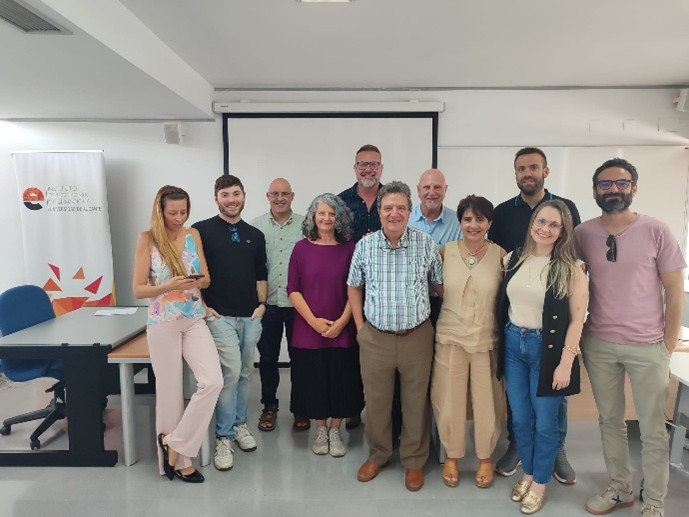
Participants of the INSEAI Seminar at the University of Alicante (October 3, 2025), held at the Institute of International Economics, where researchers discussed informal work and its role in shaping social structures.
Just a few days later, Alicante hosted a lively session on “Informal work and its analogies”. Coordinated by Raúl Lorente (UV), the seminar brought together researchers from Spain, Argentina, and Brazil — among them Agustín Salvia, Luiza Dantas, and Santos Ruesga — to reflect on how informality reshapes the social structure and everyday life.
Meanwhile, in València, the team welcomed Agustín Salvia and Ianina Tuñón (UBATEC/UCA) for a deep comparative conversation on job quality and socio-productive dynamics across Europe and Latin America. Their dialogue connected very different contexts — Germany, Spain, Poland, Argentina — around a shared question: what does “decent work” mean when informality becomes the norm?
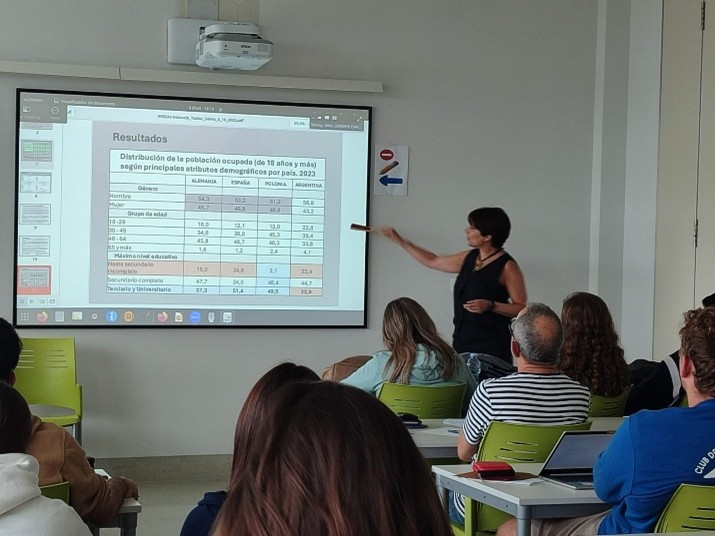
Ianina Tuñón (ODSA-UCA, Argentina) presenting comparative data on job quality and informality across Germany, Spain, Poland and Argentina during her lecture at the Universitat de València (October 6, 2025).
Discussion Series
INSEAI’s online discussion series kept the conversation going. On October 9, Pablo Granovsky and Fernando Larrosa (ITRAS – Fuocra/Untref, Argentina) revisited the ILO’s 2025 report on “Innovative Approaches to Address Informality.” Their talk reminded us that tackling informality is not just about regulation — it’s about understanding the social and institutional landscapes that sustain it.
Later in the month, Nara Álvarez and Julieta Constantino took the virtual stage with “Gender and Work.” Drawing from their research on Argentina’s Potenciar Trabajo programme, they brought to light how gender and informality intersect — showing the persistent gaps women face even within initiatives aimed at inclusion.
New Iniciatives: INSEAI Testimony Collection
The INSEAI Testimony Collection also gained momentum this month. Through a series of short interviews, Agustín Salvia, Roberto Dell’Anno, and Anabela Mesquita shared what informality means in their regions — from structural inequalities in Latin America to the digital transitions of Southern Europe. Each testimony adds another voice to a growing mosaic of perspectives that enrich the network’s dialogue.
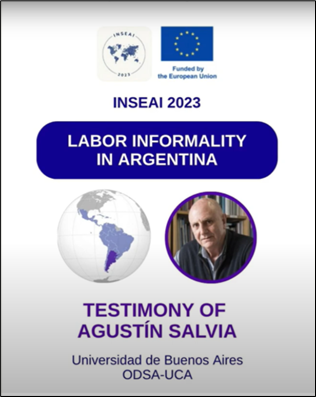
One of the latest contributions to the INSEAI Testimony Collection: Agustín Salvia (ODSA-UCA, Argentina) reflects on the roots and persistence of labor informality in Latin America.
Visits and collaborations
In early October, Santos Ruesga, INSEAI Coordinator, met with Manuel Silva and colleagues at the Polytechnic Institute of Porto. The visit reinforced the partnership and explored ways to integrate digital tools into future research on informality.
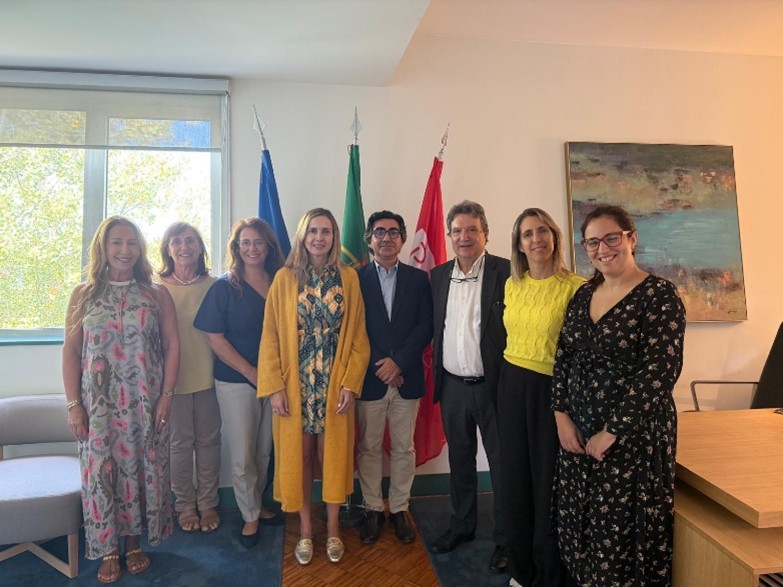
At the Polytechnic Institute of Porto, Santos Ruesga met with Manuel Silva and colleagues to explore new ways of using digital innovation in the study of informality and to reinforce collaboration within the INSEAI network.
At the same time, in València, Ianina Tuñón and Agustín Salvia completed their secondments with the local team, continuing the academic exchange and comparative work that lies at the heart of INSEAI’s mission.
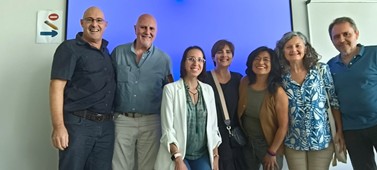
Members of the Universidade Federal Fluminense and Universitat de València teams during a joint session held as part of INSEAI’s Training Activities, focused on comparative approaches to labor informality.
Members of the Universidade Federal Fluminense and Universitat de València teams during a joint session held as part of INSEAI’s Training Activities, focused on comparative approaches to labor informality.
Routledge Handbook of the Informal Economy — Edited by Ceyhun Elgin (Routledge, 2024)
A brand-new, comprehensive handbook that captures today’s most relevant debates on informality — from tax evasion and informal employment to digitalisation and globalisation. It’s an essential reference for anyone exploring the evolving borders between formal and informal work.
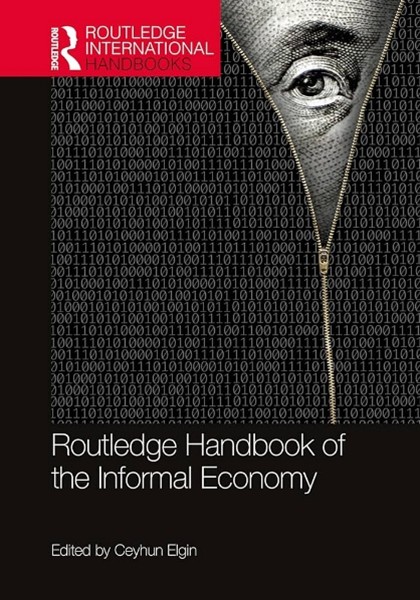
Source: Routledge (2024).
Website: www.inseai.eu
Email: newsletter@inseai.eu
LinkedIn: https://www.linkedin.com/in/inseai-project-471875371
Instagram: https://www.instagram.com/inseai.project/
Facebook: https://www.facebook.com/people/Inseai/61576239562950/
YouTube: https://www.youtube.com/@INSEAI-PROJECT
Spotify: https://open.spotify.com/
Calendar l Upcoming Events: https://www.inseai.eu/es/eventos

International Network for Knowledge and Comparative Socioeconomic Analysis of Informality and the Policies to be Implemented for their Formalization in the European Union and Latin America
Horizon Europe Project 101182756 — INSEAI 2023