

Beyond Informality: Popular Economies, Gender, and Temporalities in Northern Argentina
Florencia Antonella Nieva (National University of Jujuy).
In many cities of Northern Argentina, economic practices become visible in everyday life: neighborhood fairs, food stalls and street vending, family workshops and community kitchens, especially among people who are far from traditional wage employment relationships, the majority of whom are women. These activities are often grouped under the category of informality. However, in recent years the term popular economy (PE) has also gained traction, seeking to explain these diverse forms of work while simultaneously valuing them, emphasizing their potential: generating livelihoods for millions of households excluded (totally or partially) from regulated employment.
Although in Argentina these practices correlate directly with processes of expulsion from the formal labor market following the 1990s, the historical depth of many of them is much greater and intertwines with processes of temporal multiplicity.
At an “immediate” level of time would be the practices and strategies for sustaining households on a daily basis. Street vending, marketing of agricultural and livestock products, community kitchens, recycling, textile production, and various urban services form a heterogeneous network of activities whose common feature is the centrality of one’s own labor power and the absence of a stable wage.
Among everyday life experiences, the expression “living day to day” repeatedly appears. This phrase encapsulates the structural precarity of not having predictable income or sustained savings capacity. However, immediacy should not be confused with improvisation. Workers deploy complex strategies of calculation and administration: rotating savings systems, family loans, articulations between countryside and city, and distribution of tasks across generations.
Many women describe labor trajectories marked by rural-urban migrations, prior domestic work, or intermittent insertions into formal employment, and note that PE currently allows them greater flexibility in terms of time, remuneration, and articulation with care tasks than wage labor. In numerous cases, activities appear as continuations of family production and commercialization circuits, especially in street vending or fairs. At the stalls, grandmothers, mothers, and daughters are found simultaneously, revealing the transgenerational dimension of work.
Here the economy is not organized around accumulation, but around sustaining life. Earnings are primarily directed toward the immediate reproduction of the household: food, rent, and children’s education. Economic planning is subordinated to the urgency of guaranteeing minimum subsistence conditions. From feminist economics, this scenario allows problematizing the classic division between production and reproduction. Women not only produce goods for the market, but integrate commercial and domestic tasks within the same workday. They sell with their children beside the stall, coordinate community kitchens, manage state resources, and sustain care work. Thus, a double exploitation is configured: productive and reproductive. But a resignification of work also emerges, where reproduction ceases to be invisible and becomes public practice.
A second level would correspond to medium time, linked to historical processes spanning several decades, where PE could be situated as a sphere within the so-called informal sector around unemployment. The structural transformations of the 1990s in Argentina (privatizations, economic opening, deindustrialization, and the 2001 crisis) marked a rupture in the centrality of wage employment as the axis of social integration.
In that context, movements of unemployed workers emerged, whose practices such as roadblocks (piquetes), community soup kitchens (ollas populares), and assemblies configured new forms of collective action. Women played a fundamental role in these experiences, especially in organizing reproductive tasks that made the sustainability of protest possible.
Over time, a decisive categorical shift occurred: from “unemployed” to “workers of the popular economy.” This change was not merely nominal, but strategic and political, as it enabled contesting the recognition of activities carried out outside the formal labor market as socially necessary work. The formation of the Confederation of Workers of the Popular Economy (CTEP) and, subsequently, the Union of Workers of the Popular Economy (UTEP), along with the enactment of the Social Emergency Law, partially consolidated this process of institutionalization. The Complementary Social Wage implied an incipient recognition of the existence of work beyond formal employment.
However, this institutionalization did not eliminate tensions. In the capital of Jujuy province, for example, PE is addressed as part of an urban phenomenon to be regulated. Formalization is linked to paying a fee and obtaining precarious authorization to occupy public space, while the activity is presented as something “exceptional” and control predominates in official discourse. At the provincial level, training and micro-entrepreneurship are promoted, although frequently under the figure of the individual entrepreneur, depoliticizing the collective dimension of work.
The politicization of reproduction appears clearly here: community kitchens, territorial organization, and protest days are not activities parallel to work, but constitutive parts of it. The central demand is not assistance, but recognition. The claim of one interviewee—“we do not ask for work because we already work”—expresses a dispute over the legitimate definition of work and access to rights.
A third and final level would correspond to the long duration. In Jujuy, PE is inscribed in a territory traversed by indigenous presence and historical circuits of exchange between rural and urban zones. Practices such as pasanaku (or pasamanos) refer to community forms of reciprocity that predate contemporary neoliberalism and are reconfigured in the present. Family agricultural and livestock circuits, where women commercialize products from the rural sphere, show the continuity of Andean economic knowledge.
The notion of temporal multiplicity allows us to understand that these times do not succeed each other linearly, but coexist. PE, in this sense, is not simply a product or consequence of neoliberal exclusion, but the expression of a deeper historical fabric where capitalist, community, and state logics intertwine.
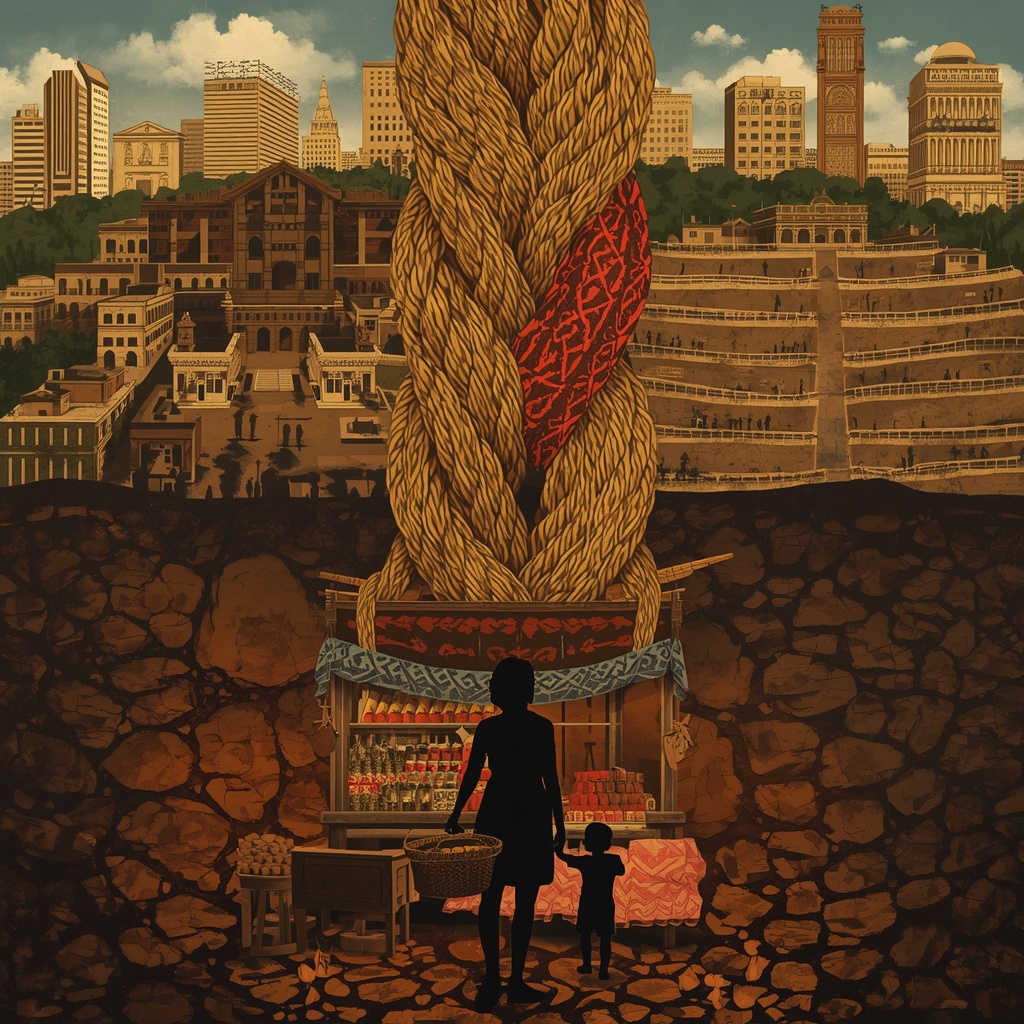
These three temporalities indicated here are not hierarchized nor do they form a linear genealogy. They function as a braid. At the sales stall, the urgency of the day, the memory of centuries-old struggles, and the continuity of ancestral community practices coexist. The identities that emerge are multiple and situated. The same woman can be a merchant, mother, territorial leader, and heir to a family productive circuit. PE does not constitute itself as a homogeneous sector, but as a space of internal disputes, power logics, and tensions, traversed by gender inequalities, migration, and racialization. Within this framework, social reproduction ceases to be a secondary sphere and becomes central to the production of value and political conflict. PEs compel us to rethink the relationship between work, gender, and citizenship from the Global South. In this context, the category of informality, viewed as an economically backward sector within capitalism, would explain the logics of PE only partially, in one of its temporalities.
Public formalization policies usually start from an implicit assumption: that there exists a normative model of wage labor toward which economic practices should converge. However, ethnographic analysis shows that PE is not simply a set of incomplete economic practices or part of a transition process, but a fabric of dense social configurations, with its own rationalities, community networks, and specific forms of articulation between production and reproduction.
In broad regions of Latin America, these activities have been nodal axes of the production and reproduction of life within a framework of structural heterogeneity. The question that emerges then is not only how to formalize, but what it means to formalize when what is at stake is not only an economic activity, but a way of organizing life. Is it possible to design formalization policies that do not dismantle networks of reciprocity, family arrangements, and collectively constructed strategies historically built? In other words: if informality is not absence of form, but specific historical forms, what kind of formalization policies could dialogue with this historicity without deactivating it?

International Network for Knowledge and Comparative Socioeconomic Analysis of Informality and the Policies to be Implemented for their Formalization in the European Union and Latin America
Horizon Europe Project 101182756 — INSEAI 2023